


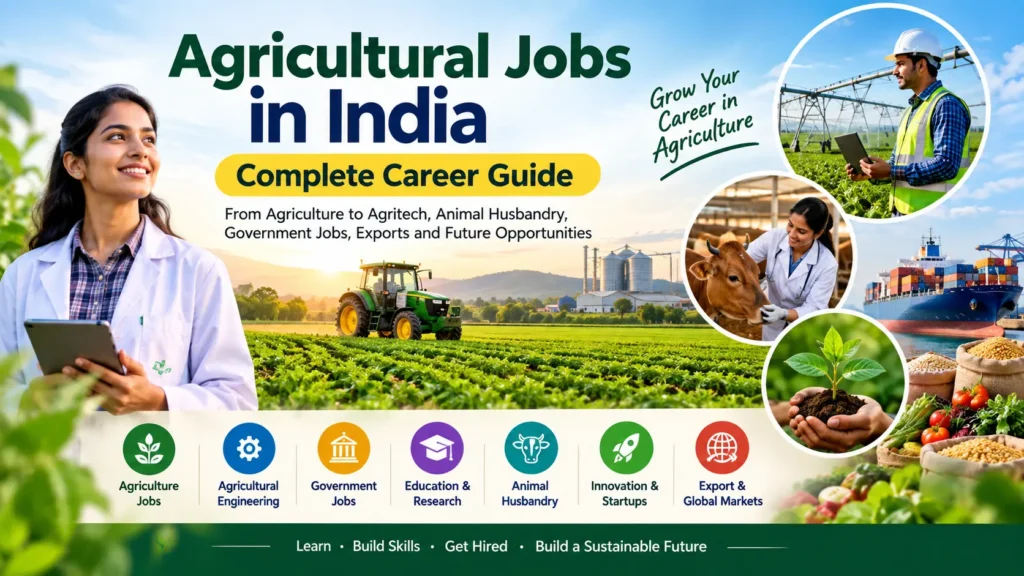
Agricultural Jobs in India: Complete Career Guide for Agriculture, Agricultural Engineering, Government Jobs, Agritech, Animal Husbandry, Exports and Future Opportunities
Agriculture is no longer limited to farming with traditional tools or working on family-owned agricultural land. Modern Indian agriculture is becoming a technology-driven industry involving agricultural engineering, biotechnology, food processing, drones, artificial intelligence, precision farming, irrigation, agri-fintech, supply chains, exports, animal husbandry, dairy, fisheries, renewable energy and agritech startups.
For India’s youth, this transformation is creating career opportunities at almost every educational level—from ITI, diploma and undergraduate candidates to B.Sc. Agriculture, B.Tech Agricultural Engineering, veterinary graduates, food technologists, scientists, MBA graduates, researchers and Ph.D. scholars.
The opportunity is particularly important because agriculture connects several large economic sectors. A young professional can enter government service, research, manufacturing, banking, education, farm management, food processing, logistics, export, consulting or entrepreneurship.
The Indian Council of Agricultural Research (ICAR) regularly publishes recruitment opportunities ranging from Young Professionals and project staff to scientific and technical positions. Its current vacancy portal illustrates how broad the employment ecosystem has become.
1. What Does an Agricultural Career Actually Mean?
An agricultural career can begin at the farm but does not have to end there.
The modern agriculture value chain looks approximately like this:
Seed → Soil → Farm → Irrigation → Machinery → Crop Production → Harvesting → Storage → Processing → Packaging → Logistics → Marketing → Export → Consumer
Every stage requires people.
For example, producing tomatoes requires agronomists and farmers, but also irrigation engineers, agricultural machinery operators, soil scientists, cold-chain professionals, food technologists, packaging specialists, quality-control officers, logistics managers, exporters, digital marketers and financial professionals.
This is why agriculture should be viewed as an ecosystem rather than a single occupation.
2. Major Agricultural Career Areas in India
| Career Area | Examples of Jobs | Suitable Qualifications |
|---|---|---|
| Agriculture | Agriculture Officer, Field Officer, Agronomist | B.Sc Agriculture, M.Sc Agriculture |
| Agricultural Engineering | Agricultural Engineer, Irrigation Engineer, Farm Machinery Engineer | B.Tech Agricultural Engineering |
| Research | Scientist, Research Associate, SRF, Project Scientist | M.Sc/M.Tech/Ph.D |
| Government | Agriculture Officer, Technical Officer, Extension Officer | Agriculture-related degree |
| Banking | Agriculture Field Officer, Rural Development Officer | Agriculture degree + banking exam |
| Food Processing | Food Technologist, QC Officer, Production Officer | Food Technology/Agriculture |
| Agritech | Agri Data Analyst, Product Manager, Farm Technology Specialist | Agriculture + technology |
| Animal Husbandry | Veterinary Officer, Livestock Development Officer | BVSc & AH / relevant qualifications |
| Dairy | Dairy Technologist, Dairy Development Officer | Dairy/Food/Agriculture qualifications |
| Seeds | Seed Technologist, Production Officer, Quality Officer | Agriculture/Seed Science |
| Fertilizer & Agrochemicals | Technical Officer, Sales Officer, Research roles | Agriculture/Chemistry/Engineering |
| Exports | Export Executive, Quality Specialist, Trade Analyst | Agriculture/Food/Management |
| Education | Lecturer, Assistant Professor, Professor | PG/Ph.D + required eligibility |
| Entrepreneurship | Agri-startup founder, FPO entrepreneur | Agriculture + business skills |
3. Agricultural Engineering: One of the Most Important Future Careers
Agricultural Engineering combines engineering with agriculture.
It deals with the machines, infrastructure, water, energy and technologies required to make agriculture more productive and efficient.
A B.Tech Agricultural Engineering graduate can potentially work in:
- Farm machinery
- Tractors and agricultural equipment
- Irrigation systems
- Soil and water conservation
- Renewable energy
- Food processing
- Cold storage
- Agricultural automation
- Drones
- Precision agriculture
- GIS and remote sensing
- Post-harvest technology
- Farm infrastructure
- Agricultural robotics
- Manufacturing
- Government engineering departments
- Research institutions
- Agritech companies
Why Agricultural Engineering has a strong future
Indian agriculture faces challenges involving water availability, fragmented land holdings, labour availability, mechanisation, climate variability, post-harvest losses and productivity.
Engineering can address many of these problems.
A future agricultural engineer may work on:
Drone-based crop monitoring + AI disease detection + automated irrigation + soil sensors + satellite imagery + farm machinery + digital farm records.
This makes agricultural engineering particularly attractive for students who enjoy both engineering and practical agricultural problems.
4. Government Agricultural Organisations
The Government of India and state governments operate a very large agricultural ecosystem.
Some of the most important organisations and institutions include:
Indian Council of Agricultural Research — ICAR
ICAR is one of India’s most important agricultural research and education networks. It works through numerous institutes, agricultural universities, research centres and Krishi Vigyan Kendras.
Its employment ecosystem includes:
- Scientists
- Technical officers
- Research staff
- Young Professionals
- Senior Research Fellows
- Research Associates
- Administrative staff
- Laboratory staff
- Field staff
- Project personnel
- Agricultural extension professionals
ICAR’s current vacancy listings demonstrate that recruitment occurs across scientific, technical, project and professional categories.
Agricultural Scientists Recruitment Board — ASRB
ASRB is particularly important for candidates interested in agricultural research and teaching.
It conducts recruitment examinations including Agricultural Research Service (ARS) and examinations for Subject Matter Specialist (SMS), Senior Technical Officer (STO) and other positions. It also conducts the National Eligibility Test (NET) for eligibility for lecturer/assistant professor positions in agricultural universities.
Department of Agriculture & Farmers Welfare
The central agricultural administration provides opportunities through different departments, schemes, missions and programmes. State Agriculture Departments are equally important employers for Agriculture Officers, Extension Officers, technical personnel and field-level staff.
Agricultural Universities
India has a large network of State Agricultural Universities, Central Agricultural Universities and other agricultural institutions.
Career opportunities include:
- Assistant Professor
- Associate Professor
- Professor
- Scientist
- Technical Assistant
- Laboratory Assistant
- Farm Manager
- Research Associate
- Project Assistant
- Administrative posts
- Field positions
5. Agricultural Government Jobs: What Vacancies Can Youth Expect?
Agricultural vacancies can be broadly divided into five categories.
Category 1: Scientific and Research Jobs
Examples:
- Agricultural Scientist
- Scientist
- Research Associate
- Senior Research Fellow
- Junior Research Fellow
- Project Scientist
- Technical Officer
- Subject Matter Specialist
These positions generally require specialised qualifications.
Category 2: Agricultural Administration
Examples:
- Agriculture Officer
- Assistant Agriculture Officer
- Extension Officer
- Development Officer
- Technical Officer
- Agriculture Inspector
- Field Officer
Recruitment is frequently conducted through State Public Service Commissions, agriculture departments and other government agencies.
Category 3: Banking and Rural Finance
Agriculture graduates can also enter financial institutions.
A particularly well-known pathway is the Agriculture Field Officer route through banking recruitment.
The work can involve:
- Agricultural loans
- Crop loans
- Farm finance
- Kisan Credit Card-related activities
- Rural credit
- Dairy and allied-sector financing
- Agricultural project appraisal
Category 4: Agricultural Universities
Candidates with postgraduate and research qualifications can pursue teaching and academic careers.
Category 5: Project and Contract Jobs
These are often overlooked.
ICAR institutes and agricultural projects may recruit:
- Young Professionals
- Field Assistants
- Project Assistants
- Research Fellows
- Technical staff
- Consultants
- Research Associates
Such appointments can provide valuable experience even when they are not permanent government positions.
For example, ICAR-CRIDA’s recruitment page currently shows Young Professional, Senior Research Fellow and Research Associate/project opportunities.
6. Major Exams for Agriculture Careers
Students should not prepare for only one examination.
Agricultural careers have several examination routes.
| Examination/Recruitment Route | Career Direction |
|---|---|
| ICAR AIEEA PG | Agricultural PG admissions |
| ICAR AICE-JRF/SRF | Ph.D/research |
| ASRB NET | Agricultural teaching eligibility |
| ASRB ARS | Agricultural research career |
| ASRB SMS/STO | Scientific/technical positions |
| State PSC Agriculture Exams | Agriculture Officer and related posts |
| Banking Agriculture Officer recruitment | Rural/agricultural banking |
| UPSC/SSC examinations | General government careers |
| University recruitment | Teaching/research/technical posts |
| Departmental recruitment | Agriculture administration |
| Project recruitment | Research and field projects |
The National Testing Agency conducts ICAR’s postgraduate and Ph.D.-related examinations, including AIEEA (PG) and AICE-JRF/SRF (Ph.D.).
Candidates should always verify the current notification because eligibility, age limits, examination structure and subjects can change.
7. Education: Which Course Should Students Choose?
There is no single agricultural qualification that is best for everyone.
After Class 10
Students can consider:
- Diploma in Agricultural Engineering
- Agricultural diploma programmes
- ITI-related technical programmes
- Vocational agriculture courses
After Class 12
Possible pathways include:
B.Sc Agriculture
Best suited for students interested in crop science, agronomy, soil, plant protection, agricultural extension and farm management.
B.Tech Agricultural Engineering
Best suited for students interested in machinery, irrigation, automation, engineering and agricultural technology.
Other possibilities include:
- Horticulture
- Forestry
- Fisheries
- Dairy Technology
- Food Technology
- Biotechnology
- Veterinary Science
- Agricultural Economics
After Graduation
Students can specialise through:
- M.Sc Agriculture
- M.Tech Agricultural Engineering
- MBA Agribusiness
- Agricultural Economics
- Food Technology
- Plant Biotechnology
- Soil Science
- Agronomy
- Horticulture
- Entomology
- Plant Pathology
- Seed Science
- Agricultural Extension
- Agricultural Statistics
Research Career
For advanced research and academic careers:
B.Sc/B.Tech → M.Sc/M.Tech → Ph.D → Scientist/Professor/Researcher
can be a strong long-term pathway.
8. Agriculture and Animal Husbandry: A Powerful Connection
Agriculture and animal husbandry should not be treated as completely separate sectors.
They are economically interconnected.
A farm can produce:
Crops + Dairy + Poultry + Goat/Sheep + Fisheries + Fodder + Compost
This creates a diversified agricultural enterprise.
For example:
Crop residue → Animal feed
Animal manure → Organic fertiliser
Livestock → Milk/meat/eggs
Farm → Fodder production
This is called an integrated farming system.
The Department of Animal Husbandry and Dairying operates within the Ministry of Fisheries, Animal Husbandry and Dairying and maintains recruitment and service-related opportunities for veterinary and other positions.
Department of Animal Husbandry and Dairying
Students interested in the livestock side can consider:
- Veterinary Science
- Dairy Technology
- Animal Husbandry
- Livestock Management
- Poultry Science
- Animal Nutrition
- Veterinary Public Health
- Dairy processing
Veterinary graduates can pursue government veterinary services, animal hospitals, livestock development, research, dairy, private practice and animal-health industries.
9. Agriculture Meets Technology: The Rise of Agritech
One of the biggest changes in Indian agriculture is the emergence of Agritech.
Agritech means using technology to solve agricultural problems.
Technologies include:
- Artificial Intelligence
- Machine Learning
- Drones
- Satellite imagery
- IoT sensors
- GPS
- GIS
- Cloud computing
- Mobile applications
- Digital marketplaces
- Blockchain
- Robotics
- Automated irrigation
- Weather analytics
- Remote sensing
Imagine a farmer receiving an alert:
“Your crop has a high probability of fungal infection. Irrigate only after checking soil moisture. Apply the recommended treatment after expert confirmation.”
This is where agriculture becomes a technology career.
A student with B.Sc Agriculture + data analytics may find opportunities that were not available to previous generations.
Similarly:
B.Tech + Agriculture
can become a powerful combination for agricultural automation.
10. Agricultural Startups and Entrepreneurship
Agriculture is increasingly becoming an entrepreneurial sector.
Young people can create businesses in:
- Farm machinery rental
- Drone services
- Soil testing
- Precision agriculture
- Farm advisory
- Organic products
- Food processing
- Cold-chain services
- Agricultural logistics
- Seed distribution
- Dairy technology
- Livestock services
- Farm-to-consumer platforms
- Export businesses
- Agri-finance
- Agricultural insurance technology
- Farm management software
The opportunity is particularly large because millions of farmers do not necessarily need to purchase expensive machinery themselves.
Instead, a startup can provide:
“Agricultural Machinery as a Service.”
For example, a young entrepreneur could operate drones, harvesters, tractors or precision spraying equipment and charge farmers on a per-acre basis.
This converts expensive capital equipment into a service business.
11. Innovation in Indian Agriculture
The next generation of agricultural innovation is likely to focus on five major objectives:
1. Produce More
Increase productivity without proportionally increasing land and water consumption.
2. Waste Less
Improve:
- Storage
- Cold chains
- Packaging
- Processing
- Transportation
3. Use Less
Reduce unnecessary:
- Water
- Fertiliser
- Pesticides
- Energy
4. Earn More
Farmers need greater value addition and better market access.
5. Adapt to Climate Change
Agriculture will increasingly require:
- Drought-resistant varieties
- Heat-tolerant crops
- Efficient irrigation
- Weather forecasting
- Crop insurance
- Climate-smart agriculture
- Soil conservation
This creates jobs for scientists, engineers, data analysts, entrepreneurs and field professionals.
12. Agriculture, Food Processing and Industry
Agriculture does not end when a crop leaves the farm.
Industrial agriculture includes:
Seeds → Fertilisers → Farm Equipment → Production → Harvesting → Processing → Packaging → Storage → Distribution → Retail
Therefore agricultural graduates can work in private companies manufacturing:
- Tractors
- Harvesters
- Irrigation equipment
- Pumps
- Seeds
- Fertilisers
- Biopesticides
- Agrochemicals
- Food products
- Animal feed
- Agricultural sensors
- Cold-storage systems
Food processing creates another major employment layer.
Examples include:
- Fruit processing
- Vegetable processing
- Dairy products
- Grain milling
- Spices
- Ready-to-eat foods
- Frozen foods
- Dehydrated products
- Nutraceutical ingredients
- Packaged agricultural products
13. Agricultural Exports: A Huge Future Opportunity
India is not only a major agricultural producer; it is also an important agricultural exporter.
APEDA reports that India’s agricultural products contributed US$51.91 billion in exports during 2024–25, while APEDA-monitored products represented a major portion of agricultural exports.
Indian agricultural and processed food products reach more than 200 countries and regions according to APEDA’s FarmerConnect information.
Important export sectors include:
- Rice
- Spices
- Fruits
- Vegetables
- Processed foods
- Marine products
- Meat products
- Dairy products
- Organic products
- Millets
- Groundnuts
- Cashews
- Floriculture
- Seeds
APEDA AgriXchange export portal
Export creates jobs beyond farming:
- Export executives
- Quality-control professionals
- Food technologists
- Packaging specialists
- International marketing professionals
- Trade analysts
- Documentation specialists
- Logistics professionals
- Supply-chain managers
- SPS/compliance specialists
APEDA’s official portal also provides market intelligence, trade opportunities, export documentation guidance, quality information and information about international markets.
14. What About Salaries?
Agriculture does not have one salary structure.
Income depends heavily on the sector, qualification, employer and experience.
A broad career hierarchy may look like:
| Career | Potential Income Pattern |
|---|---|
| Field Assistant | Entry-level |
| Agricultural Technician | Entry to mid-level |
| Young Professional | Project-based |
| Agriculture Officer | Government structured pay |
| Agricultural Engineer | Entry to senior professional |
| Research Scientist | Higher professional/research career |
| Professor | Senior academic career |
| Agritech Specialist | Highly variable |
| Export Manager | Industry-dependent |
| Agribusiness Manager | Industry-dependent |
| Entrepreneur | Potentially unlimited but risky |
Government positions generally offer structured pay, allowances and career progression according to applicable rules.
Private-sector salaries can vary considerably.
Entrepreneurial income can be much higher—but there is also substantially greater risk.
Therefore students should not select agriculture solely on the basis of starting salary.
15. Scope for Girls and Women in Agriculture
Agricultural careers are not restricted to physically demanding farm work.
Women can build careers in:
- Agricultural research
- Biotechnology
- Food technology
- Agricultural engineering
- Agritech
- Teaching
- Banking
- Agricultural economics
- Export
- Quality assurance
- Entrepreneurship
- Veterinary science
- Dairy technology
- Food processing
- Government administration
Technology is further reducing dependence on physically intensive work.
A woman agricultural engineer, for example, can work in agricultural robotics, GIS, farm machinery design, software, research or project management.
16. How Should Students Prepare for Agricultural Government Jobs?
Preparation should begin with identifying the exact career.
Strategy 1: Decide Your Specialisation
Do not prepare for every agriculture examination simultaneously.
Choose one primary direction:
Research
or
Government Agriculture Department
or
Banking
or
Teaching
or
Agricultural Engineering
or
Agritech
or
Entrepreneurship
Strategy 2: Build Subject Knowledge
Agriculture aspirants should develop strong fundamentals in:
- Agronomy
- Soil Science
- Horticulture
- Plant Pathology
- Entomology
- Genetics
- Plant Breeding
- Agricultural Economics
- Agricultural Extension
- Agricultural Engineering
- Animal Husbandry
- Current agricultural schemes
Strategy 3: Follow Government Notifications
Candidates should regularly monitor:
- ICAR
- ASRB
- NTA
- State PSC
- State Agriculture Departments
- Agricultural Universities
- NABARD
- Government recruitment portals
- Individual ICAR institutes
Strategy 4: Develop Technology Skills
Even traditional agriculture students should consider learning:
- Excel
- Data analysis
- GIS
- Remote sensing
- Basic programming
- Digital marketing
- Agricultural databases
- Presentation skills
These skills can differentiate candidates in private industry and startups.
17. Jobs Without a Competitive Examination
Agriculture offers an important advantage: not every job requires a major national competitive examination.
Private companies may recruit through:
- Campus placements
- Interviews
- Aptitude tests
- Technical interviews
- Internships
- Walk-in recruitment
- Project experience
- Direct applications
Research institutes may advertise project-based positions such as Young Professionals, Research Associates and project staff.
ICAR’s current vacancy listings provide examples of such recruitment routes.
Therefore, a student who does not want to spend years preparing for competitive examinations can still build an agriculture career.
18. Agriculture + MBA: An Underrated Combination
An agriculture graduate who studies management can move away from purely technical roles.
Possible careers include:
- Agribusiness Manager
- Procurement Manager
- Rural Marketing Manager
- Supply Chain Manager
- Commodity Manager
- Export Manager
- Product Manager
- Business Development Manager
- Agri-finance professional
- FPO consultant
This combination is particularly useful for candidates who want to enter the corporate sector.
19. Agriculture + Data Science: A Future-Proof Combination
Agriculture generates enormous amounts of data.
Examples:
- Rainfall
- Soil moisture
- Temperature
- Crop yield
- Satellite images
- Commodity prices
- Disease occurrence
- Farm inputs
- Market demand
A professional who understands both agriculture and data can help answer questions such as:
Which crop should be planted?
When should irrigation occur?
Which field has crop stress?
What will the expected yield be?
Where is demand increasing?
This creates a new category of employment at the intersection of agriculture and technology.
20. Agriculture + Animal Husbandry + Dairy
A particularly promising area for rural entrepreneurship is integrated agriculture.
A farmer could combine:
Crop production + dairy + poultry + goat farming + fodder + compost + food processing
instead of depending on a single crop.
This can distribute risk.
For example, poor crop prices do not necessarily destroy the entire household income if dairy or livestock provides another revenue stream.
Animal husbandry also creates professional careers beyond farming.
These include:
- Veterinarians
- Animal nutritionists
- Dairy technologists
- Feed specialists
- Livestock managers
- Poultry specialists
- Breeding specialists
- Animal health professionals
- Dairy plant professionals
The government maintains separate recruitment and service frameworks for veterinary and animal-husbandry positions.
21. Important Official Websites for Agriculture Aspirants
| Organisation | What to Look For |
|---|---|
| ICAR | Recruitment, institutes, education, research |
| ASRB | ARS, NET, SMS/STO and recruitment |
| NTA ICAR | PG and Ph.D. entrance examinations |
| DAHD | Animal husbandry, dairy and veterinary opportunities |
| APEDA | Agricultural exports and export opportunities |
| Agricultural Universities | Admissions, teaching and recruitment |
| State Agriculture Departments | State-level vacancies and schemes |
| NABARD | Rural development and agriculture-related careers |
| Food Processing Ministry | Food processing opportunities |
| FSSAI | Food safety and regulatory careers |
Department of Animal Husbandry and Dairying
22. What Is the Future of Agriculture for Indian Youth?
The future is significantly broader than traditional farming.
The agricultural professional of the future may be:
Farmer + Engineer + Data User + Entrepreneur + Exporter
rather than simply a producer of crops.
The major growth areas are likely to include:
- Precision agriculture
- Agricultural drones
- AI-based farm advisory
- Climate-smart agriculture
- Agricultural biotechnology
- Seed technology
- Protected cultivation
- Hydroponics and controlled-environment agriculture
- Food processing
- Cold-chain infrastructure
- Agricultural exports
- Farm mechanisation
- Digital agriculture
- Agrifintech
- Livestock technology
- Dairy technology
- Fisheries technology
- Agricultural logistics
- FPO development
- Agricultural entrepreneurship
The export opportunity is also substantial. APEDA’s current data shows the scale of India’s agricultural trade, while its programmes and market-information systems demonstrate the increasing importance of export-oriented agriculture.
23. Pros and Cons of an Agricultural Career
Advantages
- Huge and essential economic sector
- Multiple government employment pathways
- Strong research opportunities
- Growing agritech industry
- Scope for entrepreneurship
- International export opportunities
- Opportunity to work with technology
- Rural and urban career options
- Agriculture connects with food, banking, engineering and logistics
- Strong scope for specialised postgraduate education
Challenges
- Some government examinations are highly competitive
- Rural jobs may involve field work
- Private-sector salaries vary significantly
- Research careers may require postgraduate qualifications
- Farming itself carries climate and market risks
- Entrepreneurship requires capital and market knowledge
- Some agricultural careers require relocation
- Government recruitment can be irregular
The key lesson is that agriculture is promising, but candidates should specialise rather than assume that every agriculture degree automatically guarantees a government job.
24. A Career Roadmap for Indian Students
Class 10
Develop interest in science, mathematics, biology and technology.
Class 12
Choose an appropriate science/agriculture pathway.
Undergraduate
Choose:
B.Sc Agriculture / B.Tech Agricultural Engineering / Veterinary / Food Technology / Horticulture / Fisheries / Dairy Technology
During College
Build:
- Internship experience
- Communication
- Computer skills
- Industry exposure
- Research projects
- Competitive-exam awareness
After Graduation
Choose one:
Government Job
Research
Higher Education
Corporate Agriculture
Agritech
Banking
Export
Entrepreneurship
After PG
Consider:
Scientist / Professor / Specialist / Researcher / Consultant / Senior Industry Role
Conclusion: Agriculture Is Becoming a Technology and Business Career
Agriculture remains one of India’s most important sectors, but the definition of an agricultural job is changing rapidly.
The future will not be based only on traditional crop cultivation.
It will increasingly involve engineering, artificial intelligence, biotechnology, drones, robotics, irrigation, food processing, animal husbandry, dairy, logistics, finance, exports and entrepreneurship.
For students who love science and technology, Agricultural Engineering can provide an especially interesting bridge between engineering and farming.
For students interested in research, ICAR and ASRB provide important pathways. ASRB’s current recruitment framework includes ARS, SMS, STO and NET-related examinations, while ICAR’s vacancy system demonstrates the breadth of project, professional, technical and scientific recruitment.
For students interested in international business, agricultural exports offer another expanding career ecosystem. India’s agricultural exports were worth about US$51.91 billion in 2024–25, according to APEDA’s current information.
For rural entrepreneurs, the combination of crop production + dairy + livestock + food processing + direct marketing can create diversified businesses.
Most importantly, Indian youth should stop thinking of agriculture simply as “working on a farm.”
The modern agriculture sector needs:
Scientists. Engineers. Veterinarians. Data analysts. Software developers. Agribusiness managers. Exporters. Food technologists. Researchers. Bankers. Entrepreneurs. Teachers. Drone operators. Machinery specialists. Supply-chain professionals.
That is why agriculture can become one of the most diverse career ecosystems for India’s next generation.
The best strategy for a young aspirant is therefore not merely to ask:
“Is there a government agriculture job?”
The better question is:
“Which part of India’s enormous agriculture value chain can I become exceptionally good at?”
That approach can open doors to government service, research, industry, startups, exports and entrepreneurship—and make agriculture a modern, technology-driven and financially meaningful career for India’s youth.
Agricultural Jobs in India – Frequently Asked Questions
Candidates looking for Agricultural Jobs in India can explore opportunities in agriculture, agricultural engineering, research, government departments, banking, food processing, agritech, animal husbandry, dairy, exports, education and entrepreneurship. The exact eligibility, vacancies, salary, deadlines and selection process depend on the organisation and recruitment notification.
1. What are Agricultural Jobs in India?
Agricultural Jobs in India include careers in agriculture, agricultural engineering, research, government departments, banking, food processing, agritech, animal husbandry, dairy, seeds, agrochemicals, agricultural exports, education and agricultural entrepreneurship. Opportunities are available at different educational levels, depending on the post.
2. What is the eligibility for Agricultural Jobs?
Eligibility depends on the specific post. Candidates may qualify with Class 10, Class 12, ITI, diploma, B.Sc Agriculture, B.Tech Agricultural Engineering, postgraduate qualifications, veterinary qualifications, food technology qualifications, MBA or Ph.D. The exact educational qualification, age limit and other conditions must be checked in the relevant recruitment notification.
3. Are there Agricultural Government Jobs in India?
Yes. Agricultural government career opportunities are available through organisations, departments, agricultural universities, research institutions, State Agriculture Departments and other government agencies. Posts may include Agriculture Officer, Extension Officer, Technical Officer, Scientist, Research Associate, Field Officer and project-related positions.
4. How many vacancies are available in Agricultural Jobs?
There is no single fixed number of Agricultural Jobs vacancies in India because recruitment is conducted separately by different organisations and departments. Vacancy numbers change with each notification. Candidates should check the latest official recruitment advertisement for the exact number of posts, category-wise vacancies and reservation details.
5. What is the last date to apply for Agricultural Jobs?
There is no common last date for all Agricultural Jobs. Every organisation announces its own application schedule. Candidates should check the official notification for the opening date, closing date, correction window, examination date and other important deadlines. Applications should preferably be submitted well before the closing date.
6. What salary can candidates expect from Agricultural Jobs?
Salary varies significantly according to the organisation, post, qualification, experience, recruitment rules and employment type. Permanent government positions may follow the applicable pay level and allowances, while research projects, internships, fellowships and private-sector positions may have different remuneration structures. Candidates should check the official notification for the exact salary or stipend.
7. How can I apply for Agricultural Jobs?
Candidates should first identify a suitable recruitment notification and carefully check the eligibility conditions. Applications may be submitted online through the recruiting organisation’s official website or, where specified, through an offline application process. Candidates should complete the application accurately, upload the required documents, pay the applicable fee if required and save the application confirmation.
8. What documents are generally required for Agricultural Job applications?
Depending on the recruitment, candidates may need educational certificates and mark sheets, proof of date of birth, identity proof, photographs, signature, category certificate where applicable, experience certificates, disability or other applicable certificates and other documents specified in the notification. Candidates should upload only the documents requested by the recruiting organisation.
9. What is the selection procedure for Agricultural Jobs?
The selection procedure depends on the recruitment. It may include a written examination, computer-based test, interview, skill test, practical test, document verification, academic merit or a combination of these stages. Research and project positions may use qualification, experience, interview or presentation-based selection. Candidates should follow the selection process mentioned in the individual notification.
10. Which exams are important for an Agricultural career?
Important routes can include ICAR-related postgraduate and research examinations, ASRB examinations such as ARS and NET, State Public Service Commission agriculture examinations, banking Agriculture Field Officer recruitment, university recruitment, departmental recruitment and other government examinations. The appropriate examination depends on the candidate’s qualification and intended career path.
11. What is the exam pattern for Agricultural Government Jobs?
There is no single exam pattern for all Agricultural Government Jobs. Depending on the recruitment, an examination may contain agriculture or technical subjects, general knowledge, reasoning, quantitative aptitude, English or other subjects. Some recruitments may not have a written examination. Candidates should always follow the latest official syllabus and examination pattern.
12. Where can candidates be posted after selection?
Posting location depends on the recruiting organisation and the post. Candidates may be posted in agricultural departments, research institutes, laboratories, farms, agricultural universities, banks, field offices, food-processing units, project locations or other offices across India. Some recruitments may specify state-wise, region-wise or institute-specific posting requirements.
13. Is there an application fee for Agricultural Jobs?
The application fee depends on the recruitment authority. Some government examinations charge an application or examination fee, while certain research, project, fellowship or recruitment processes may have no fee. Candidates should check the official notification for the applicable fee and any exemptions available to eligible categories.
14. Can B.Sc Agriculture candidates get government jobs?
Yes. B.Sc Agriculture graduates can find career opportunities in agriculture departments, agricultural research, banking, agricultural universities, agritech companies, food and agricultural businesses, rural development and other related areas. However, eligibility differs from one post to another, so candidates should match their qualification with the requirements of each notification.
15. What career opportunities are available after B.Tech Agricultural Engineering?
B.Tech Agricultural Engineering graduates can explore agricultural engineering, irrigation, farm machinery, automation, agricultural technology, research, government departments, manufacturing, agritech, precision agriculture, food processing and related technical careers. Depending on the recruitment, they may also be eligible for technical and engineering-related government positions.
16. Are there Agricultural Jobs in the private sector and agritech companies?
Yes. The private agricultural ecosystem includes agritech startups, seed companies, food-processing businesses, agricultural machinery manufacturers, irrigation companies, agrochemical companies, supply-chain businesses, agricultural finance, logistics, export companies and technology providers. Roles can include agronomist, agri-data analyst, product manager, technical officer, quality specialist, sales professional and farm technology specialist.