


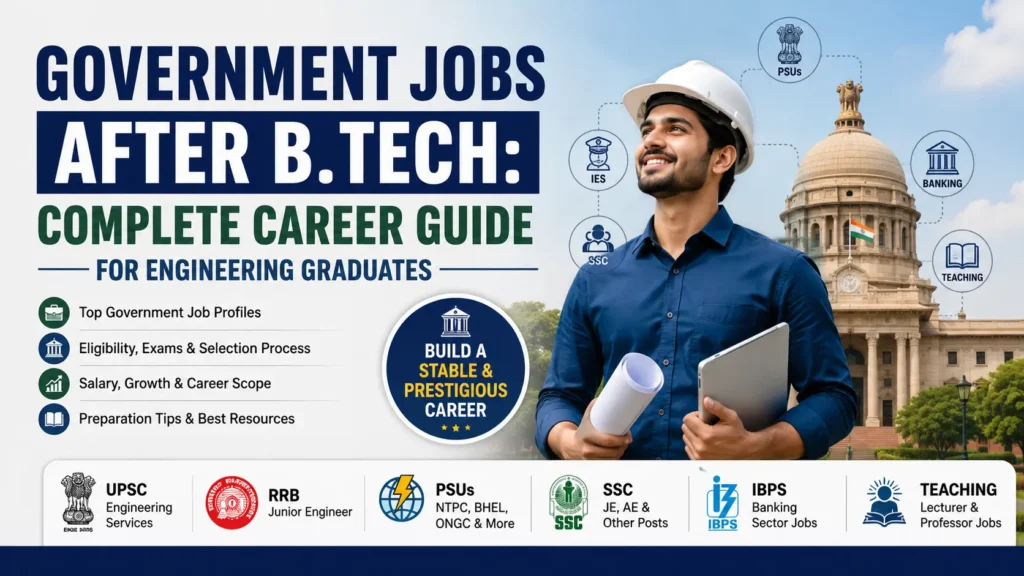
Government Jobs After B.Tech: Complete Career Guide for Engineering Graduates
Looking for government jobs after B.Tech? Engineering graduates can explore opportunities in PSUs, Railways, ISRO, DRDO, Defence organizations, SSC, UPSC, State Government departments, research organizations and several other public-sector institutions. This complete guide explains the major career opportunities, recruitment routes, GATE and non-GATE options, jobs with and without conventional written examinations, preparation strategies, advantages, disadvantages and application tips.
Why Consider Government Jobs After B.Tech?
Completing a B.Tech degree opens the door to a wide range of career options. While many engineering graduates move into the private sector, government organizations and public-sector companies also offer significant opportunities for qualified engineers.
Government engineering careers can be found in sectors such as energy, petroleum, defence, space research, transportation, infrastructure, telecommunications, manufacturing, scientific research and public works. The exact opportunities available to a candidate depend on the engineering specialization and the eligibility conditions mentioned in the recruitment notification.
There is also no single examination that covers every government job after B.Tech. Some recruitment is conducted through national competitive examinations, some organizations use GATE scores, and some recruit through their own written examinations, interviews or other selection methods.
For example, UPSC currently conducts the Engineering Services Examination, while SSC conducts the Junior Engineer examination for Civil, Mechanical and Electrical disciplines. ISRO also recruits B.E./B.Tech graduates for Scientist/Engineer positions through different routes depending on the recruitment cycle. :contentReference[oaicite:1]{index=1}
Government Organizations That Employ B.Tech Graduates
B.Tech graduates should not restrict their search to one or two famous organizations. A large number of government departments, PSUs, research institutions and public-sector companies recruit engineers from time to time. Vacancies and eligibility requirements can change from one recruitment cycle to another.
| Organization / Sector | Possible Engineering Areas | Possible Recruitment Route |
|---|---|---|
| ISRO | Electronics, Mechanical, Computer Science, Civil, Electrical and other notified disciplines | GATE-based or written-test recruitment depending on notification |
| DRDO | Electronics, Mechanical, Computer Science, Electrical, Chemical and other technical fields | Organization-specific recruitment |
| ONGC | Mechanical, Electrical, Civil, Chemical, Petroleum and related disciplines | GATE and/or organization-specific recruitment depending on vacancy |
| NTPC | Electrical, Mechanical, Electronics, Civil and other relevant disciplines | GATE / organization-specific recruitment |
| POWERGRID | Electrical, Electronics, Civil and related engineering fields | Recruitment route specified in individual notification |
| BHEL | Mechanical, Electrical, Electronics, Civil and other disciplines | Organization-specific recruitment |
| IOCL | Mechanical, Civil, Electrical, Chemical and other relevant disciplines | Recruitment as specified by the organization |
| GAIL | Mechanical, Electrical, Civil, Chemical and other engineering disciplines | Organization-specific recruitment / applicable national score |
| HAL | Mechanical, Electrical, Electronics, Computer Science and related disciplines | Organization-specific recruitment |
| BEL | Electronics, Electrical, Mechanical, Computer Science and other disciplines | Organization-specific recruitment |
| Indian Railways | Civil, Mechanical, Electrical, Electronics and other technical fields | RRB and other notified recruitment routes |
| UPSC Engineering Services | Civil, Mechanical, Electrical, Electronics & Telecommunication | UPSC competitive examination |
| SSC JE | Civil, Mechanical and Electrical | SSC competitive examination |
| BARC | Engineering and scientific disciplines | Recruitment route specified in notification |
| CSIR Laboratories | Engineering, scientific and technical disciplines | Regular/project recruitment as notified |
| BRO | Civil, Mechanical and related technical disciplines | Recruitment as notified |
| CPWD | Civil, Electrical and related engineering fields | Applicable government recruitment routes |
| MES | Civil, Electrical, Mechanical and related fields | Recruitment as notified |
| Oil India Limited | Mechanical, Electrical, Civil, Chemical, Petroleum and related disciplines | Recruitment route specified in notification |
| SJVN | Civil, Electrical, Mechanical and related disciplines | Recruitment route specified in notification |
| Mazagon Dock | Mechanical, Electrical, Naval Architecture and related fields | Organization-specific recruitment |
| Cochin Shipyard | Mechanical, Electrical, Civil, Naval Architecture and related fields | Organization-specific recruitment |
| Garden Reach Shipbuilders & Engineers | Mechanical, Electrical, Naval Architecture and related fields | Organization-specific recruitment |
| Bharat Dynamics Limited | Mechanical, Electronics, Electrical and related disciplines | Recruitment as notified |
| MIDHANI | Metallurgy, Mechanical, Electrical and related disciplines | Organization-specific recruitment |
Note: This table is intended as a career guide, not a permanent eligibility list. The branches accepted, number of vacancies and selection procedure can change from one recruitment notification to another.
Branch-Wise Government Job Opportunities After B.Tech
B.Tech Civil Engineering Government Jobs
Civil Engineering graduates can explore opportunities related to roads, railways, buildings, water resources, public works, infrastructure, construction and transportation.
- UPSC Engineering Services
- SSC JE
- Railway technical recruitment
- CPWD
- MES
- BRO
- NHAI and infrastructure-related organizations
- State Public Works Departments
- State engineering services
- Water resources organizations
- PSUs recruiting Civil Engineers
B.Tech Mechanical Engineering Government Jobs
- ONGC
- NTPC
- BHEL
- Indian Railways
- ISRO
- DRDO
- HAL
- Defence PSUs
- Shipbuilding organizations
- UPSC Engineering Services
- SSC JE where eligible
- State engineering departments
B.Tech Electrical Engineering Government Jobs
- POWERGRID
- NTPC
- BHEL
- NHPC
- IOCL
- ONGC
- Indian Railways
- ISRO
- UPSC Engineering Services
- SSC JE
- State Electricity Boards
- State Power Departments
B.Tech Electronics and Communication Engineering Government Jobs
- ISRO
- DRDO
- BEL
- HAL
- Indian Railways
- Defence electronics organizations
- Telecommunication-related government organizations
- UPSC Engineering Services where eligible
- State technical departments
B.Tech Computer Science Engineering Government Jobs
B.Tech CSE graduates have opportunities in government technology, software, cybersecurity, e-governance, research, defence technology and IT-related positions. They can also apply for general graduate-level examinations where a recognized bachelor’s degree is the required qualification.
- ISRO
- DRDO
- NIC and government technology organizations
- Defence technology organizations
- Government IT and e-governance projects
- PSU IT positions
- Railway technology positions
- State Government IT departments
- Graduate-level government examinations
B.Tech Chemical Engineering Government Jobs
- ONGC
- IOCL
- GAIL
- Oil India
- Fertilizer-sector PSUs
- Petroleum-sector organizations
- Research organizations
- Other process and chemical-sector public enterprises
Government Jobs After B.Tech With a Written Examination
Many government engineering jobs are filled through competitive examinations. Candidates should therefore be prepared to compete with a large number of applicants.
UPSC Engineering Services Examination
The UPSC Engineering Services Examination is one of the major national-level routes for engineering graduates. UPSC’s current examination information lists Engineering Services Examination 2026, and its published papers cover Civil, Mechanical, Electrical and Electronics & Telecommunication engineering. :contentReference[oaicite:2]{index=2}
Candidates interested in this route should prepare their technical subjects thoroughly while also following the official examination pattern and syllabus.
SSC Junior Engineer
SSC conducts the Junior Engineer examination for Civil, Mechanical and Electrical engineering posts in participating Government of India organizations. The examination uses computer-based papers and includes technical engineering content. :contentReference[oaicite:3]{index=3}
B.Tech graduates should carefully check the educational qualification specified for the particular post because eligibility can vary.
Railway Recruitment
Indian Railways periodically recruits technical personnel through the Railway Recruitment Boards and other notified recruitment processes. Engineering graduates should check the exact qualification requirements before applying because some railway technical posts may have specific degree or diploma requirements.
State Engineering Examinations
State Public Service Commissions and other state recruitment bodies may conduct examinations for Assistant Engineer, Junior Engineer and other technical positions. These can be attractive options for candidates who prefer to build their career within a particular state.
Government Jobs After B.Tech Without a Conventional Written Test
One of the most common questions asked by engineering graduates is: “Can I get a government job without an exam?”
The answer requires an important clarification. No written examination does not mean no selection process.
Depending on the recruitment, an organization may shortlist candidates using GATE scores, academic qualifications, experience, project credentials or another criterion and then conduct an interview, document verification, medical examination or other selection stage.
Some possible recruitment routes include:
- GATE-score-based shortlisting
- Interview-based recruitment
- Academic-merit-based shortlisting
- Project and research recruitment
- Apprenticeship selection
- Contractual technical recruitment
- Organization-specific selection procedures
GATE-Based Government Jobs and PSU Opportunities After B.Tech
GATE can be an important route for engineering graduates who want to enter selected PSUs or technical organizations. However, candidates should not assume that every PSU uses GATE scores in every recruitment cycle.
Recruitment rules are organization-specific and may change. Therefore, the current notification should always be treated as the final authority.
Why GATE Can Be Useful
- Strong technical preparation
- Access to selected PSU recruitment opportunities
- Useful for higher technical education
- Can strengthen eligibility for some technical recruitment processes
- Creates an additional career pathway beyond general government examinations
ISRO provides a good example of why candidates should check the specific recruitment notification rather than relying on general assumptions. Its current career information describes both GATE-score-based Scientist/Engineer recruitment and B.E./B.Tech recruitment using written test plus interview. :contentReference[oaicite:4]{index=4}
Government Jobs After B.Tech Without GATE
Not having a GATE score does not mean that a B.Tech graduate has no government career options.
Depending on branch and eligibility, candidates can explore:
- SSC JE
- RRB technical recruitment
- State PSC engineering examinations
- State government engineering departments
- Organization-specific written examinations
- Defence technical recruitment
- Research/project positions
- Graduate-level government examinations
- Apprenticeships and trainee opportunities
The best strategy is to select examinations whose syllabus overlaps with your strengths instead of trying to prepare for every possible government vacancy.
Government Jobs for Fresh B.Tech Graduates
Freshers should not limit their search only to permanent engineering officer positions. Depending on the recruitment cycle, they can also consider apprenticeships, graduate trainee roles, project positions and other entry-level opportunities.
An apprenticeship can provide valuable industrial exposure, but candidates should not assume that completing an apprenticeship automatically guarantees permanent government employment.
Fresh graduates should also start preparing before the recruitment notification is released. Waiting until the application window opens can leave insufficient time for serious preparation.
How to Prepare for Government Jobs After B.Tech
Government examination preparation should begin with a clear understanding of the target examination. The preparation strategy for GATE, UPSC ESE, SSC JE and a PSU-specific examination will not be identical.
Step 1: Select Your Target
Choose one primary examination or recruitment route. You can keep one or two backup options, preferably where the syllabus overlaps.
Step 2: Download the Official Syllabus
Do not prepare only from random lists of topics found online. Start with the official syllabus and examination pattern.
Step 3: Strengthen Core Engineering Subjects
B.Tech graduates should revise the fundamental subjects of their engineering discipline. Focus on understanding concepts rather than memorizing answers.
Step 4: Solve Previous-Year Papers
Previous-year papers help you understand question difficulty, frequently tested topics, time pressure and the style of the examination.
Step 5: Take Mock Tests
Mock tests should be used not only to measure your score but also to identify careless mistakes, weak subjects and time-management problems.
Step 6: Revise Repeatedly
Create short revision notes for formulas, important concepts and frequently repeated mistakes.
6-Month Preparation Strategy
| Period | Main Focus |
|---|---|
| Month 1 | Understand syllabus, exam pattern and previous-year papers. |
| Month 2 | Build strong foundations in major technical subjects. |
| Month 3 | Continue technical preparation and start intensive question practice. |
| Month 4 | Complete remaining syllabus and increase previous-year paper practice. |
| Month 5 | Start regular full-length mock examinations. |
| Month 6 | Focus on revision, mock tests, weak areas and examination strategy. |
Daily Study Strategy for B.Tech Graduates
A realistic study schedule is more useful than an extremely long timetable that cannot be followed consistently.
| Activity | Suggested Time |
|---|---|
| Technical subjects | 2–3 hours |
| Previous-year questions | 45–60 minutes |
| Aptitude / reasoning where required | 30–45 minutes |
| Revision | 30 minutes |
| Mock test | Weekly initially; increase later |
The exact number of hours depends on your circumstances. Consistency, question practice and revision are generally more important than simply counting study hours.
How to Prepare for Government Job Interviews
Some recruitment processes include an interview after written-test or GATE-based shortlisting. Candidates should therefore prepare for both technical and personal questions.
Important Areas to Prepare
- Core engineering subjects
- Final-year project
- Internship experience
- Practical engineering concepts
- Basic knowledge about the recruiting organization
- Recent developments in the relevant industry
- Questions related to your engineering branch
A common mistake is memorizing interview answers without understanding the underlying concept. Interviewers may ask follow-up questions, so conceptual understanding is much more valuable.
Government Job Application Strategy for B.Tech Graduates
Finding a suitable vacancy is only the first step. Many candidates lose an opportunity because they fail to check an eligibility condition or miss an application deadline.
- Read the complete official recruitment notification.
- Check whether your B.Tech branch is eligible.
- Check the minimum percentage or CGPA requirement.
- Check the age limit.
- Check age relaxation rules where applicable.
- Check whether final-year candidates are eligible.
- Check experience requirements.
- Check application fees.
- Check the selection process.
- Check examination syllabus and pattern.
- Apply before the closing date.
- Save the application form and payment receipt.
Pros and Cons of Government Jobs After B.Tech
Advantages
- Generally strong employment stability
- Structured pay scales and allowances
- Long-term career progression
- Leave and employee benefits according to applicable rules
- Retirement-related benefits according to the applicable system
- Opportunities to work on public infrastructure and national projects
- Technical careers in sectors such as space, defence, energy and transportation
- Opportunities in both central and state government organizations
Disadvantages
- Very high competition for popular posts
- Recruitment processes can take time
- Vacancies can be limited in prestigious organizations
- Transfers or remote postings may occur
- Promotion structures can be more rigid than some private companies
- Administrative procedures can be significant
- Private-sector careers may provide faster salary growth in some specialized fields
Government Job vs Private Job After B.Tech
There is no universally “best” career option. The right choice depends on your priorities, skills and long-term goals.
| Factor | Government | Private |
|---|---|---|
| Job Stability | Generally high | Depends on company and market |
| Salary Structure | Generally structured | Varies significantly |
| Salary Growth | Structured according to rules | Can be faster in some sectors |
| Recruitment | Often competitive | Company hiring process |
| Flexibility | Usually structured | Varies by employer |
Can B.Tech Graduates Apply for Non-Technical Government Jobs?
Yes. A B.Tech degree does not restrict a graduate to engineering positions. Where a government recruitment notification accepts any recognized bachelor’s degree, engineering graduates may also be eligible.
Therefore, B.Tech graduates can consider both technical and general graduate-level government recruitment, provided they satisfy the eligibility requirements.
How to Avoid Fake Government Job Notifications
Government jobs are highly popular, and this unfortunately creates opportunities for fraudulent recruitment advertisements and fake appointment offers.
- Check the recruiting organization’s official website.
- Read the official PDF notification.
- Check the advertisement number.
- Check the application URL carefully.
- Never believe claims of guaranteed government selection.
- Do not pay an unofficial person for a job.
- Do not share OTPs or banking credentials with unknown individuals.
- Save the official notification for future reference.
ISRO itself currently warns candidates about fake offers of appointment in connection with its recruitment. :contentReference[oaicite:5]{index=5}
Quick Comparison of Major Government Job Routes After B.Tech
| Route | Exam | Interview | Typical Candidates |
|---|---|---|---|
| GATE + PSU | GATE | Depends on organization | Engineering graduates |
| UPSC ESE | Yes | As per selection process | Eligible engineering graduates |
| SSC JE | Yes | Selection rules apply | Civil, Mechanical, Electrical candidates |
| RRB Technical | Usually | Depends on post | Eligible technical candidates |
| Project / Research | May or may not | Often | Technical/research candidates |
| Apprenticeship | Depends | Depends | Fresh graduates |
Frequently Asked Questions About Government Jobs After B.Tech
1. Which government job is best after B.Tech?
The best government job depends on your engineering branch, career goals, salary expectations, preferred location and interest in technical or administrative work. Major options include PSUs, UPSC Engineering Services, ISRO, DRDO, Railways, SSC JE and State Engineering Services.
2. Can I get a government job after B.Tech without GATE?
Yes. GATE is not compulsory for every government job. Candidates can explore SSC JE, RRB recruitment, State PSC engineering examinations, organization-specific recruitment and other eligible government vacancies.
3. Is GATE compulsory for PSU jobs?
No. Some PSUs use GATE scores while others may use their own recruitment examinations or other selection procedures. Candidates should check the latest notification of the particular organization.
4. Can B.Tech CSE graduates get government jobs?
Yes. CSE graduates can find opportunities in government technology, software, cybersecurity, research, defence technology, e-governance, Railways, PSUs and graduate-level government examinations where eligible.
5. Which government exams are suitable for B.Tech graduates?
Depending on branch and eligibility, candidates can consider GATE, UPSC Engineering Services, SSC JE, RRB technical examinations, State PSC engineering examinations, defence technical recruitment and organization-specific examinations.
6. Can final-year B.Tech students apply for government jobs?
It depends on the recruitment notification. Some recruitments allow final-year candidates subject to specified conditions, while others require the degree to be completed by a particular date.
7. Which B.Tech branch has the most government job opportunities?
Civil, Mechanical, Electrical, Electronics and Computer Science graduates can all find government opportunities. However, the number of vacancies varies by organization and recruitment cycle, so no single branch can permanently be considered the “best.”
8. Is SSC JE suitable for B.Tech graduates?
It can be suitable for eligible B.Tech graduates in the relevant disciplines. SSC JE covers Civil, Mechanical and Electrical engineering posts, but candidates must check the educational qualification for the particular recruitment.
9. Can I get a government job without a written examination?
Some recruitment processes may not use a conventional written examination. They may instead use GATE scores, academic merit, interviews, project selection or another selection method. However, no written examination does not mean automatic selection.
10. Is a government job better than a private job after B.Tech?
Neither is universally better. Government employment may appeal to candidates who prioritize stability and structured benefits, while private-sector careers may offer faster salary growth and greater flexibility in some industries.
Key Takeaway for B.Tech Graduates
Government jobs after B.Tech are not limited to one examination or one organization. Engineering graduates can explore opportunities in PSUs, Railways, Defence, Space, Research, Power, Petroleum, Infrastructure, State Government departments and other public-sector organizations.
The most important step is to identify the recruitment route that matches your engineering branch and career goals. If you want PSU opportunities, GATE may be an important pathway for selected organizations. If you prefer competitive examinations, UPSC ESE, SSC JE, RRB and State Engineering examinations may be worth considering where eligible.
Start preparing before the notification arrives, read every official notification carefully and never apply without checking your exact eligibility.
Related Government Job Resources
You may also find these resources useful while searching for government jobs:
Disclaimer
This article is intended for general career guidance and informational purposes. Government recruitment rules, vacancies, age limits, educational qualifications, salary, selection procedures and application dates may change from one recruitment cycle to another.
Candidates should always read the latest official recruitment notification issued by the concerned organization before applying. No information in this article should be considered a guarantee of eligibility, selection, appointment or employment.




