


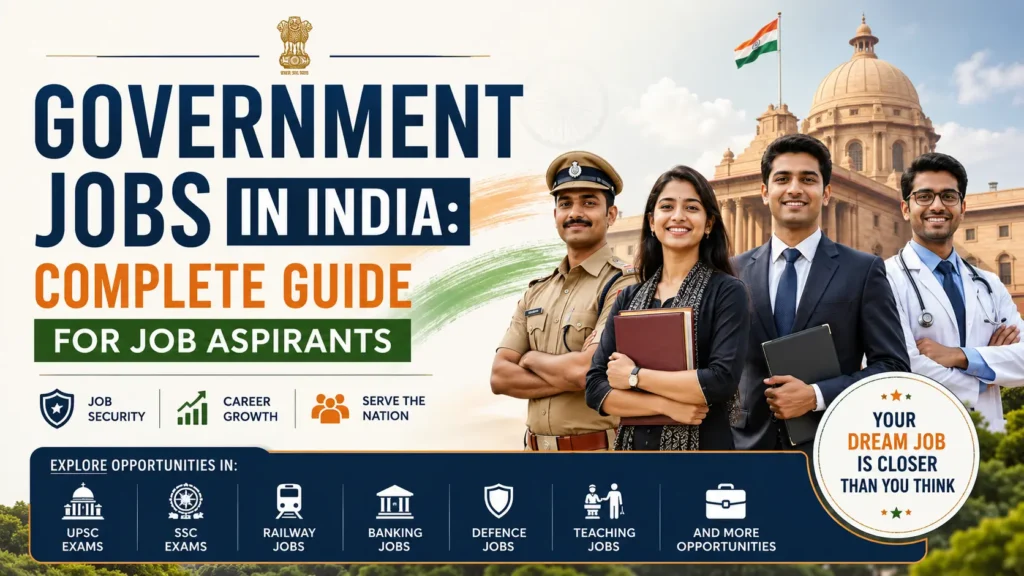
Government Jobs in India: Complete Guide for Job Aspirants
Government jobs in India continue to attract millions of candidates every year. For many aspirants, a government job offers more than employment. It can provide job stability, structured career growth, social security, retirement benefits, and opportunities to serve the country.
However, the government job sector is extremely broad. There are opportunities for candidates who have passed 10th, 12th, ITI, Diploma, Graduation, Engineering, Postgraduation, Medicine, Law, Management and other professional qualifications.
The biggest challenge is not simply finding a government job. The real challenge is identifying the right examination, organization and career path according to your qualification and interests.
This guide explains the major government job opportunities in India, important competitive examinations, recruiting organizations, eligibility levels, selection processes and preparation strategies.
What Are Government Jobs in India?
Government jobs are employment opportunities offered by the Central Government, State Governments, government departments, constitutional bodies, public sector organizations, banks, railways, defence organizations, research institutions and other public institutions.
Government recruitment can happen through:
- Competitive examinations
- Direct recruitment
- Skill or trade tests
- Interviews
- Recruitment based on professional qualifications
- Apprenticeship recruitment
- Physical tests
- Written examinations followed by interviews or document verification
For example, the Union Public Service Commission (UPSC) conducts examinations for several major government services, while the Staff Selection Commission (SSC) recruits candidates for numerous Group B and Group C positions.
Similarly, banking recruitment is conducted through organizations such as IBPS and SBI, while Railway Recruitment Boards recruit candidates for various railway positions.
Why Are Government Jobs Popular in India?
Government employment has traditionally been considered attractive because of its combination of stability, structured pay scales and career progression.
Some commonly sought-after advantages include:
1. Job Stability
Government employment generally provides greater employment stability than many private-sector jobs, subject to the applicable service rules.
2. Salary and Allowances
Government employees may receive basic pay along with applicable allowances and benefits according to the rules governing their post and organization.
3. Career Progression
Many government positions have clearly defined promotion structures.
4. Diverse Career Options
Government recruitment is not limited to administrative jobs.
Candidates can pursue careers in:
- Administration
- Banking
- Railways
- Defence
- Police
- Engineering
- Medicine
- Teaching
- Research
- Information Technology
- Statistics
- Finance
- Law
- Science
- Public-sector management
5. Opportunities Across Educational Levels
A major advantage of the government employment sector is the availability of jobs for different educational qualifications.
Government Jobs According to Educational Qualification
One of the easiest ways to understand the government job sector is to classify opportunities according to qualification.
| Qualification | Examples of Government Job Opportunities |
|---|---|
| 10th Pass | MTS, Railway Level-1 posts, Constable, Technician/Trade-related posts |
| 12th Pass | SSC CHSL, Railway NTPC undergraduate posts, Stenographer, Defence opportunities |
| ITI | Technician, Trade Apprentice, Railway Technician, Defence technical posts |
| Diploma | Junior Engineer, Technical Assistant, Technician, PSU/departmental technical posts |
| Graduation | SSC CGL, UPSC, Banking, Railway graduate posts, State PSC |
| Engineering | Engineering Services, PSU recruitment, ISRO, DRDO, Railway JE/technical posts |
| Postgraduation | Lecturer, Research, Specialist posts, regulatory and departmental recruitment |
| Medical Degree | UPSC CMS, government hospitals, medical colleges and health departments |
| Law Degree | Legal Officer, Judicial Services, government legal departments |
| Professional Qualifications | Specialist Officer, Chartered Accountant, Scientist, Engineer, IT and finance positions |
Important: Eligibility varies from one notification to another. Candidates should always read the official recruitment notification before applying.
Major Government Job Recruiting Organizations in India
There is no single examination through which all government jobs are recruited.
Different organizations conduct recruitment for different departments and sectors.
Government Recruitment Organization Matrix
| Organization | Major Recruitment / Exams | Suitable For |
|---|---|---|
| UPSC | Civil Services, CDS, NDA, CAPF, CMS, Engineering Services | Graduates, Engineers, Medical candidates, Defence aspirants |
| SSC | CGL, CHSL, MTS, JE, Stenographer, Selection Posts, CPO | 10th, 12th, Diploma and Graduate candidates |
| Railway Recruitment Boards | NTPC, Group D/Level-1, ALP, Technician, JE etc. | 10th, 12th, ITI, Diploma, Graduates, Engineers |
| IBPS | PO/MT, CSA, RRB, Specialist Officers | Graduates and specialists |
| SBI | PO, Junior Associate, Specialist Officer, Circle Based Officer | Graduates and specialists |
| RBI | Grade B and other recruitment | Graduates, specialists and professionals |
| DRDO | Scientist, Technical and other recruitment | Engineers, Scientists, ITI/Diploma candidates |
| ISRO | Scientist/Engineer, Technical, Administrative, Apprentice posts | Engineers, Scientists, Diploma, ITI and graduates |
| State PSCs | PCS, administrative and departmental posts | Mostly graduates |
| State Police Departments | Constable, SI and other posts | 10th, 12th and graduates depending on post |
| Teaching Recruitment Bodies | Teacher, lecturer and academic posts | TET/CTET-qualified and teaching candidates |
| Defence Recruitment | Army, Navy, Air Force and related services | 10th, 12th, graduates and technical candidates |
1. UPSC Government Jobs
The Union Public Service Commission (UPSC) is one of India’s most important recruitment bodies.
UPSC conducts several competitive examinations for prestigious government services and specialized positions.
UPSC Official Website
Major UPSC Examinations
| Examination | Broad Career Area |
|---|---|
| Civil Services Examination | IAS, IPS, Indian Foreign Service and other services |
| Indian Forest Service Examination | Forest and environmental administration |
| Engineering Services Examination | Government engineering services |
| Combined Defence Services | Defence officer entry |
| NDA & Naval Academy | Defence officer entry after 12th |
| CAPF (AC) | Assistant Commandant in Central Armed Police Forces |
| Combined Medical Services | Government medical services |
| Combined Geo-Scientist | Geological and related scientific services |
| IES/ISS | Economic and Statistical services |
UPSC’s active examination list includes Civil Services, CDS, NDA, Engineering Services, CMS, CAPF, Indian Forest Service and other examinations.
For example, the Civil Services Examination consists of a Preliminary Examination followed by the Main Examination and Personality Test/Interview stages for candidates who qualify at each stage.
The UPSC Civil Services Preliminary Examination 2026 was notified on February 4, 2026, illustrating that aspirants should monitor the annual examination calendar rather than wait until the last moment.
2. SSC Government Jobs
The Staff Selection Commission (SSC) is one of the most important recruitment organizations for candidates seeking Central Government jobs.
Staff Selection Commission Official Website
SSC conducts examinations for a wide range of Group B and Group C positions.
Major SSC Examinations
| Examination | Broad Career Area |
|---|---|
| Civil Services Examination | IAS, IPS, Indian Foreign Service and other services |
| Indian Forest Service Examination | Forest and environmental administration |
| Engineering Services Examination | Government engineering services |
| Combined Defence Services | Defence officer entry |
| NDA & Naval Academy | Defence officer entry after 12th |
| CAPF (AC) | Assistant Commandant in Central Armed Police Forces |
| Combined Medical Services | Government medical services |
| Combined Geo-Scientist | Geological and related scientific services |
| IES/ISS | Economic and Statistical services |
SSC’s official website lists examinations such as CGL, CHSL, Junior Engineer, Stenographer, Selection Posts and Sub-Inspector examinations.
Example: SSC CGL
SSC CGL is particularly popular among graduates.
A graduate can potentially compete for positions such as:
- Assistant Section Officer
- Income Tax Inspector
- Auditor
- Accountant
- Junior Statistical Officer, where applicable
- Various Group B and Group C positions
The exact posts, vacancies, eligibility and salary depend on the particular recruitment cycle.
3. Railway Government Jobs
Indian Railways is one of the largest government employment sectors in India.
Recruitment is conducted through various Railway Recruitment Boards
(RRBs) and related railway recruitment organizations.
Candidates may find opportunities in areas such as:
- Non-Technical Popular Categories
- Assistant Loco Pilot
- Technician
- Junior Engineer
- Level-1/Group D-type posts
- Paramedical positions
- Ministerial and isolated categories
Railway Jobs by Qualification
| Qualification | Possible Railway Opportunities |
|---|---|
| 10th Pass | Level-1 and certain technical/trade opportunities |
| 10th + ITI | Technician and trade-related opportunities |
| 12th Pass | Undergraduate NTPC-type posts |
| Graduation | Graduate NTPC-type posts |
| Diploma | Technical/engineering posts |
| Engineering Degree | Junior Engineer and other technical opportunities |
| Medical Qualification | Railway medical/paramedical recruitment |
Candidates should use the official Railway Recruitment Board/railway recruitment portals mentioned in the relevant notification rather than relying on unofficial application links.
4. Banking Government and Public-Sector Bank Jobs
Banking is another major career path for government-job aspirants.
Recruitment opportunities are available through:
- IBPS
- SBI
- RBI
- Other public-sector banks
- Regional Rural Banks
The Institute of Banking Personnel Selection (IBPS) conducts common recruitment processes for participating organizations, including PO/MT, Customer Service Associate, Regional Rural Banks and Specialist Officer recruitment.
IBPS Official Website
Major Banking Exams
| Exam | Typical Qualification | Career |
|---|---|---|
| IBPS PO/MT | Graduation | Probationary Officer/Management Trainee |
| IBPS CSA | Graduation | Customer Service Associate |
| IBPS RRB Officer | Graduation | Officer in Regional Rural Banks |
| IBPS RRB Office Assistant | Graduation | Office Assistant |
| IBPS Specialist Officer | Relevant professional qualification | Specialist Officer |
| SBI PO | Graduation | Probationary Officer |
| SBI Junior Associate | Graduation | Clerical/Customer Support role |
| SBI Specialist Officer | Relevant professional qualification | Specialist roles |
| RBI Grade B | Graduation/specialized qualifications depending on stream | Officer-level regulatory career |
SBI’s career information confirms recruitment opportunities for Probationary Officers, Junior Associates and specialist roles.
SBI Careers – Current Openings
5. RBI and Regulatory Body Jobs
The Reserve Bank of India (RBI) is another highly sought-after employer.
RBI Opportunities and Vacancies
RBI recruitment can include:
- Grade B Officers
- Specialist officers
- Research-related positions
- Young Professionals
- Consultants
- Technical and engineering positions
- Other specialist vacancies
RBI maintains an official opportunities portal and specifically warns candidates about fraudulent recruitment communications.
This is an important lesson for every government-job aspirant: always verify recruitment information from the official organization website.
6. Defence Government Jobs
Defence is another major government career sector.
Candidates can explore opportunities in:
- Indian Army
- Indian Navy
- Indian Air Force
- Coast Guard
- Central Armed Police Forces
- Defence research organizations
Major Defence Examinations
| Exam/Recruitment | Conducting Organization | Broad Eligibility |
|---|---|---|
| NDA | UPSC | 12th Pass |
| CDS | UPSC | Graduation |
| AFCAT | Indian Air Force | Graduation/technical qualifications depending on entry |
| CAPF AC | UPSC | Graduation |
| Army Recruitment | Indian Army | Varies |
| Navy Recruitment | Indian Navy | Varies |
| Air Force Recruitment | Indian Air Force | Varies |
UPSC’s active examinations include NDA, CDS and CAPF examinations.
Candidates interested in defence careers should carefully check physical standards, medical requirements, age limits and educational qualifications before applying.
7. DRDO Government Jobs
The Defence Research and Development Organisation (DRDO) offers opportunities in scientific, engineering and technical fields.
DRDO Official Recruitment/Vacancies
DRDO recruitment can involve different routes.
The Recruitment and Assessment Centre (RAC) handles recruitment programmes for scientists, while CEPTAM manages direct recruitment for technical positions such as Technician and Senior Technical Assistant roles.
This makes DRDO particularly interesting for:
- Engineers
- Scientists
- Diploma holders
- ITI candidates
- Technical professionals
8. ISRO Government Jobs
For candidates interested in science, engineering and space technology, Indian Space Research Organisation (ISRO) is an important government employer.
ISRO Careers
ISRO opportunities can include:
- Scientist/Engineer
- Technical Assistant
- Scientific Assistant
- Technician
- Administrative Officer
- Assistant
- Junior Personal Assistant
- Apprenticeship
- Research positions
ISRO’s career information shows opportunities across scientific, technical and administrative categories.
The organization’s current opportunities page also demonstrates that recruitment is not limited to scientists; recent listings have included Scientist/Engineer, Assistant, Junior Personal Assistant, UDC, Stenographer and apprenticeship positions.
Government Jobs After 10th Pass
Candidates who have completed Class 10 should not assume that graduation is necessary for every government job.
Possible opportunities include:
| >Job Area | >Example |
|---|---|
| Central Government | SSC MTS |
| Railway | Level-1/entry-level recruitment |
| Defence | Certain entry-level opportunities |
| Police | Constable recruitment, depending on state |
| Technical | ITI-based technician/trade posts |
| Apprenticeship | Government organizations and PSUs |
Candidates with ITI qualifications should also monitor technical recruitment because their qualification can open opportunities unavailable to candidates with only Class 10.
Government Jobs After 12th
Class 12 is an important qualification level because several competitive examinations become available.
Important Options
| >Examination | >Qualification | >Career Area |
|---|---|---|
| SSC CHSL | 12th | Central Government clerical/data-entry posts |
| SSC Stenographer | 12th | Stenography |
| RRB NTPC Undergraduate | 12th | Railway non-technical posts |
| NDA | 12th | Defence officer entry |
| State Police | Often 12th | Police |
| Various departmental recruitment | 12th | Clerical/technical positions |
Students who are still in Class 12 should therefore start building basic skills in:
- Mathematics
- Reasoning
- English
- General Awareness
- Computer knowledge
- Current affairs
Government Jobs After Graduation
Graduation opens the largest range of competitive government job opportunities.
A graduate can consider:
- UPSC Civil Services
- SSC CGL
- Banking exams
- Railway graduate-level recruitment
- State PSC
- Police Sub-Inspector recruitment
- CAPF
- Defence officer examinations
- RBI and regulatory recruitment
- Teaching
- Department-specific recruitment
Graduate Jobs Matrix
| Career Preference | Exams/Recruitment to Consider |
|---|---|
| Administration | UPSC CSE, State PSC |
| Central Government Office | SSC CGL |
| Banking | IBPS PO, SBI PO |
| Railway | RRB graduate-level recruitment |
| Defence | CDS, CAPF |
| Police | SSC CPO, State SI |
| Finance/Regulation | RBI and other regulatory recruitment |
| Technical | Engineering-specific recruitment |
| Research | DRDO, ISRO and research organizations |
| Teaching | TET/teacher recruitment/lecturer recruitment |
State Government Jobs
Not every aspirant wants to work for the Central Government.
Every state has its own recruitment ecosystem.
State-level opportunities can include:
- State Public Service Commission jobs
- State SSC recruitment
- Police recruitment
- Teacher recruitment
- Health department recruitment
- Revenue department jobs
- Secretariat jobs
- Junior Engineer recruitment
- Patwari/revenue-related posts
- Forest department jobs
- Municipal recruitment
Examples include:
- UPPSC
- BPSC
- MPPSC
- RPSC
- HPSC
- HPPSC
- MPSC
- WBPSC
- TNPSC
- KPSC
- JPSC
- UKPSC
Candidates should identify their state first and then follow the official Public Service Commission and state recruitment websites.
Government Teaching Jobs
Teaching is another major government employment category.
Candidates can explore opportunities through:
- CTET
- State TETs
- KVS
- NVS
- State education departments
- Government schools
- Government colleges and universities
- Lecturer/Assistant Professor recruitment
However, teaching eligibility can involve specific degrees, teacher-training qualifications, TET requirements and subject-specific criteria.
Therefore, candidates should never assume that simply passing a particular examination guarantees eligibility for every teaching vacancy.
PSU Jobs
Public Sector Undertakings, commonly called PSUs, also offer attractive career opportunities.
Examples include organizations such as:
- ONGC
- NTPC
- BHEL
- SAIL
- GAIL
- IOCL
- Coal India
- HAL
- BEL
- Power Grid
- NHPC
Recruitment methods differ between organizations.
Some technical PSU recruitment may consider GATE scores, while other positions may be filled through organization-specific examinations, interviews or direct recruitment.
Therefore, engineering graduates should monitor both PSU career pages and major competitive examination routes.
Competitive Exams: One Syllabus Can Open Multiple Doors
A smart government-job strategy is to identify examinations with overlapping syllabi.
For example, a candidate preparing for SSC CGL may already study:
- Quantitative Aptitude
- Reasoning
- English
- General Awareness
These subjects can overlap with portions of other competitive examinations.
Similarly, banking examinations involve:
- Quantitative Aptitude
- Reasoning
- English
- General Awareness
- Computer/Banking awareness depending on the examination
This means candidates can strategically prepare for multiple examinations rather than relying entirely on one recruitment cycle.
However, candidates should not prepare for ten unrelated examinations simultaneously. The better approach is to identify two or three compatible exam families.
Government Jobs Exam Strategy Matrix
| Primary Target | Backup/Parallel Options |
|---|---|
| UPSC CSE | State PSC, CAPF |
| SSC CGL | SSC CHSL, Selection Posts, Banking |
| Banking | IBPS, SBI, RRB banking exams |
| Railway | SSC, Banking, other technical recruitment |
| Engineering | SSC JE, RRB JE, PSU, ISRO, DRDO |
| Defence | NDA/CDS/CAPF/AFCAT |
| Teaching | CTET, State TET, KVS/NVS/State recruitment |
| 10th + ITI | Railway, SSC, DRDO/technical, PSU apprenticeships |
| Medical | UPSC CMS, State health departments, government hospitals |
| Research/Science | ISRO, DRDO, CSIR and research institutions |
How to Choose the Right Government Jobs?
Do not choose an examination simply because it is popular.
Ask yourself five questions.
1. What is my qualification?
Start with your highest completed qualification.
2. What type of work do I want?
Do you prefer:
- Office work?
- Field work?
- Defence?
- Police?
- Teaching?
- Engineering?
- Banking?
- Research?
- Administration?
3. Where do I want to work?
Some candidates prefer their home state, while others are comfortable with an All-India posting.
4. How much preparation time can I give?
UPSC preparation can require a very different strategy from SSC, banking or technical recruitment.
5. What are my backup examinations?
A good strategy should include realistic alternatives.
How to Prepare for Government Exams?
Step 1: Select Your Exam Family
Instead of preparing randomly, select one primary target.
For example:
- Graduate + interested in Central Government → SSC CGL
- Graduate + interested in banking → IBPS/SBI
- Engineering graduate → SSC JE/PSU/ISRO/DRDO
- 12th Pass + defence interest → NDA
Step 2: Download the Official Syllabus
Never prepare solely from coaching advertisements.
Download the official notification and syllabus.
Look carefully at:
- Subjects
- Number of questions
- Marks
- Negative marking
- Examination stages
- Age limit
- Educational qualification
- Physical requirements
- Skill tests
- Document requirements
Step 3: Create a Study Plan
A simple daily schedule can include:
| Activity | Suggested Focus |
|---|---|
| Mathematics | Concepts + practice |
| Reasoning | Questions + shortcuts |
| English | Grammar + vocabulary + comprehension |
| General Awareness | Static GK + current affairs |
| Mock Tests | Speed + accuracy |
| Previous Papers | Exam pattern understanding |
The exact allocation should depend on the examination.
Previous-Year Papers Are Extremely Important
Previous-year question papers help candidates understand what the examination actually tests.
They can reveal:
- Frequently tested topics
- Difficulty level
- Question patterns
- Time pressure
- Repeated concepts
- Important subjects
Instead of simply solving hundreds of random questions, aspirants should analyse previous papers carefully.
Mock Tests and Time Management
Government competitive examinations are often not only tests of knowledge.
They are also tests of:
- Speed
- Accuracy
- Decision-making
- Time management
- Pressure handling
A candidate who knows the syllabus but spends too much time on difficult questions can lose marks.
A useful strategy is:
Learn → Practice → Analyse → Revise → Mock Test → Analyse Again
Do not treat mock-test scores as the final measure of your ability. Use them to identify weaknesses.
How to Find Genuine Government Jobs Notifications?
This is one of the most important aspects of a government-job search.
Candidates should prioritize official websites.
Important Official Recruitment Sources
| Organization | Official Source |
|---|---|
| UPSC | UPSC Official Website |
| SSC | Staff Selection Commission Official Website |
| IBPS | IBPS Official Website |
| SBI Careers | SBI Careers – Current Openings |
| RBI Opportunities | RBI Opportunities and Vacancies |
| Railway Recruitment Board | Railway Recruitment Boards |
| ISRO Careers | ISRO Careers |
| DRDO Vacancies | DRDO Official Recruitment/Vacancies |
| National Career Service | NCS Government Jobs |
The National Career Service portal of the Ministry of Labour & Employment also provides a government-jobs search facility and lists recruitment agencies.
Beware of Fake Government Jobs Websites
Government jobs aspirants are frequently targeted by fraudulent websites and fake recruitment communications.
Common warning signs include:
- Requests for money through unofficial channels
- Fake appointment letters
- Unofficial application websites
- WhatsApp-only recruitment
- Email addresses unrelated to the recruiting organization
- Claims of guaranteed selection
- Requests for unnecessary personal information
- Fake interview calls
For example, SBI explicitly warns candidates about fake selection letters and fraudulent websites. RBI has also issued warnings regarding fake appointment communications.
Golden Rule
Always verify the recruitment notification on the official website of the recruiting organization.
Government Jobs Application Checklist
Before submitting an application, check the following:
| Checkpoint | What to Verify |
|---|---|
| Qualification | Degree/certificate matches notification |
| Age | Minimum and maximum age |
| Relaxation | Applicable category relaxation |
| Nationality | Eligibility conditions |
| Application Fee | Amount and exemption |
| Photograph | Size and format |
| Signature | Size and format |
| Documents | Required certificates |
| Exam Centre | Available choices |
| Last Date | Date and exact closing time |
| Application Number | Save after submission |
| Payment Receipt | Download/save |
| Admit Card | Monitor official website |
Never wait until the final day if you can avoid it. Technical problems, payment failures or heavy website traffic can create unnecessary stress.
Documents Commonly Required
The exact requirements vary by recruitment, but candidates may need:
- Aadhaar/identity proof
- Educational certificates
- Marksheets
- Date-of-birth proof
- Category certificate
- EWS certificate, where applicable
- Disability certificate, where applicable
- Experience certificate
- Photograph
- Signature
- NOC for government employees, where applicable
- Domicile certificate, where applicable
Candidates should read the official notification carefully because certificate formats and validity requirements can differ.
A Practical Government Job Preparation Roadmap
If you are starting from scratch, follow this simple roadmap.
- Identify Your Qualification
- Select a Career Sector
- Shortlist 2–3 Exams
- Compare Syllabus
- Start With Fundamentals
- Solve Previous Papers
- Take Regular Mock Tests
- Track Notifications
- Apply Carefully
- Keep Multiple Opportunities Open
Government Jobs: Which Exam Should You Choose?
| If You Are… | Consider These Options |
|---|---|
| 10th Pass | SSC MTS, Railway, Police, technical/trade opportunities |
| 12th Pass | SSC CHSL, SSC Stenographer, Railway, NDA |
| 12th + ITI | Railway Technician, technical government jobs, apprenticeships |
| Diploma Holder | SSC JE, Railway JE/technical recruitment, technical departments |
| Graduate | SSC CGL, UPSC, Banking, Railway, State PSC |
| Engineering Graduate | SSC JE/technical posts, PSU, ISRO, DRDO, Engineering Services |
| Medical Graduate | UPSC CMS, State health recruitment, government hospitals |
| Law Graduate | Judicial services, legal officer and departmental opportunities |
| Teaching Qualification | CTET/TET and teaching recruitment |
| Interested in Defence | NDA, CDS, CAPF, AFCAT and service-specific recruitment |
| Interested in Research | ISRO, DRDO, CSIR and research institutions |
Is Government Jobs Preparation Worth It?
Government-job preparation is not easy.
Competition can be intense, recruitment cycles can take time, and some examinations have multiple stages.
Therefore, aspirants should enter this field with realistic expectations.
A government job should not be viewed as the only definition of career success.
At the same time, for candidates who value public service, structured career progression and the nature of government employment, it can be a highly rewarding career path.
The most important thing is to choose an examination that matches your:
Qualification + Interest + Skills + Career Goals + Preparation Capacity
Final Advice for Government Jobs Aspirants
Do not chase every vacancy.
Instead, build a career strategy.
A 10th-pass candidate can start with entry-level opportunities and continue improving qualifications.
A 12th-pass candidate can target SSC, Railways, Defence and other suitable recruitment.
A graduate can explore SSC, UPSC, Banking, Railways, State PSC, Defence and specialist recruitment.
An engineer can combine technical government recruitment with PSU, ISRO, DRDO and engineering-service opportunities.
The key is to understand that government jobs are not one career path—they are hundreds of career paths under different organizations and recruitment systems.
Keep track of official notifications, understand the syllabus, solve previous-year papers, practice mock tests and apply only through genuine recruitment channels.
Most importantly, do not let one unsuccessful examination define your future.
A disciplined aspirant who understands the recruitment ecosystem and prepares strategically has far more opportunities than someone who prepares randomly.
Choose your target. Understand the examination. Build a realistic backup plan. Prepare consistently. And keep applying to opportunities that genuinely match your qualifications and career goals.
FAQs- Frequently Asked Questions – Government Jobs in India
1. What is the eligibility for this job?
Graduates from recognized universities are eligible depending on the post requirements.
2. What is the application deadline?
The application deadline is usually mentioned in the official notification; candidates must apply before the closing date.
3. How many vacancies are available?
The number of vacancies varies by department and is specified in the recruitment advertisement.
4. What is the salary structure?
Salary is based on pay level as per government norms, including allowances and benefits.
5. How can I apply for this job?
Candidates must apply online through the official recruitment portal by filling out the application form and uploading documents.
6. What documents are required?
Educational certificates, ID proof, caste certificate (if applicable), and recent passport-size photographs are required.
7. What is the selection procedure?
The selection process usually includes a written exam, skill test/interview, and document verification.
8. What is the exam pattern?
The exam pattern includes objective-type questions on General Knowledge, Reasoning, Quantitative Aptitude, and subject-specific topics.
9. Where will the posting location be?
Posting locations vary across India depending on department requirements.
10. What is the application fee?
Application fees differ by category; reserved categories may have concessions as per government rules.
11. Is there an age limit?
Yes, the age limit is specified in the notification, with relaxations for reserved categories.
12. Can I edit my application after submission?
Most portals do not allow editing after final submission, so candidates must fill carefully before submitting.




