


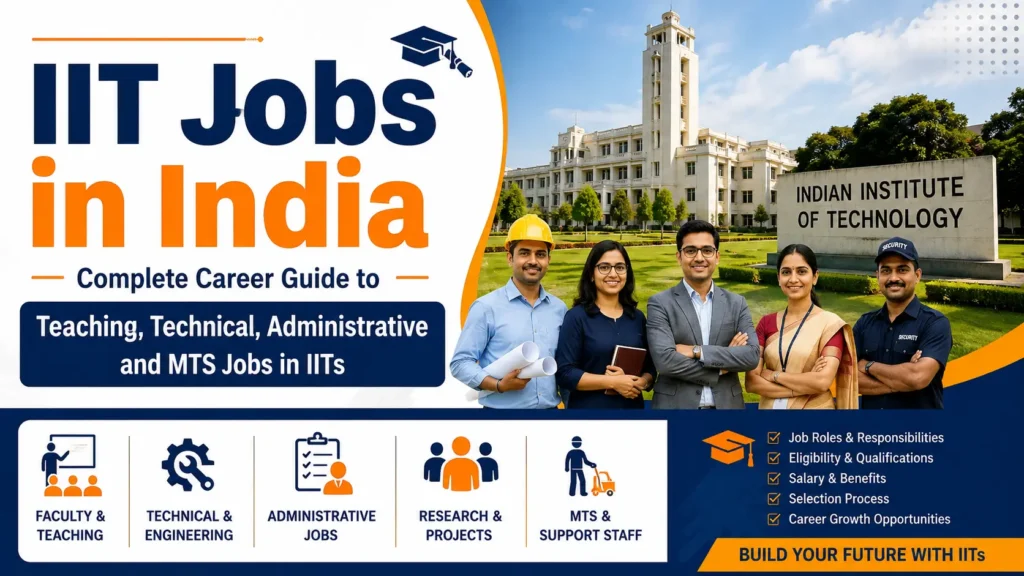
IIT Jobs in India: Complete Career Guide to Teaching, Technical, Administrative and MTS Jobs in IITs
The Indian Institutes of Technology (IITs) are among the most prestigious higher-education institutions in India. However, IITs are not only places for engineering students and researchers. The 23 IITs collectively employ a large and diverse workforce comprising professors, associate professors, assistant professors, research staff, technical officers, technicians, engineers, laboratory staff, administrative officers, librarians, medical staff, nurses, security personnel, support staff and junior assistants.
For job aspirants, IIT employment can therefore mean much more than becoming a professor. Depending on qualification and experience, opportunities are available from PhD-level faculty positions to diploma/ITI-based technical jobs and entry-level administrative or support positions.
The IITs are statutory autonomous institutions of national importance under the Institutes of Technology Act, 1961. The Ministry of Education currently lists 23 IITs across India.
Unlike many conventional Central Government departments, IIT recruitment is decentralized. Individual IITs advertise their own vacancies and conduct recruitment according to their applicable institutional framework.
That makes IIT jobs particularly interesting for candidates who want Government-sector institutional employment combined with an academic, scientific, technical or professional working environment.
IIT Jobs in India: Complete Career Guide to Teaching, Technical, Administrative and MTS Jobs in IITs
The Indian Institutes of Technology (IITs) are among the most prestigious higher-education institutions in India. However, IITs are not only places for engineering students and researchers. The 23 IITs collectively employ a large and diverse workforce comprising professors, associate professors, assistant professors, research staff, technical officers, technicians, engineers, laboratory staff, administrative officers, librarians, medical staff, nurses, security personnel, support staff and junior assistants.
For job aspirants, IIT employment can therefore mean much more than becoming a professor. Depending on qualification and experience, opportunities are available from PhD-level faculty positions to diploma/ITI-based technical jobs and entry-level administrative or support positions.
The IITs are statutory autonomous institutions of national importance under the Institutes of Technology Act, 1961. The Ministry of Education currently lists 23 IITs across India.
Unlike many conventional Central Government departments, IIT recruitment is decentralized. Individual IITs advertise their own vacancies and conduct recruitment according to their Acts, statutes, ordinances and regulations. Faculty recruitment is also handled by the respective institutions through their governing bodies.
That makes IIT jobs particularly interesting for candidates who want Government-sector stability combined with an academic, scientific, technical or professional working environment.
1. How Many IITs Are There in India?
There are currently 23 IITs in India. These institutions are located across different regions of the country and offer employment opportunities in academics, research, engineering, administration, healthcare, laboratories, information technology and support services.
| No. | IIT | Location |
|---|---|---|
| 1 | IIT Kharagpur | West Bengal |
| 2 | IIT Bombay | Maharashtra |
| 3 | IIT Madras | Tamil Nadu |
| 4 | IIT Kanpur | Uttar Pradesh |
| 5 | IIT Delhi | Delhi |
| 6 | IIT Guwahati | Assam |
| 7 | IIT Roorkee | Uttarakhand |
| 8 | IIT (BHU) Varanasi | Uttar Pradesh |
| 9 | IIT Hyderabad | Telangana |
| 10 | IIT Indore | Madhya Pradesh |
| 11 | IIT Gandhinagar | Gujarat |
| 12 | IIT Ropar | Punjab |
| 13 | IIT Patna | Bihar |
| 14 | IIT Jodhpur | Rajasthan |
| 15 | IIT Mandi | Himachal Pradesh |
| 16 | IIT Bhubaneswar | Odisha |
| 17 | IIT Tirupati | Andhra Pradesh |
| 18 | IIT Palakkad | Kerala |
| 19 | IIT Goa | Goa |
| 20 | IIT Jammu | Jammu & Kashmir |
| 21 | IIT Dharwad | Karnataka |
| 22 | IIT Bhilai | Chhattisgarh |
| 23 | IIT (ISM) Dhanbad | Jharkhand |
The Ministry of Education’s official IIT list includes all 23 institutions. IIT (ISM) Dhanbad is the present IIT associated with the former Indian School of Mines.
For job seekers, it is important to remember that each IIT can have its own recruitment portal, vacancy calendar, eligibility conditions and selection procedure.
2. Who Can Get a Job in an IIT?
One of the biggest misconceptions about IIT recruitment is that IIT jobs are only for PhD holders. In reality, the workforce is extremely diverse.
Broadly, opportunities can be divided into the following categories:
| Category | Examples of Jobs | Typical Qualification |
|---|---|---|
| Faculty | Professor, Associate Professor, Assistant Professor | PhD, academic/research experience |
| Teaching Support | Teaching Assistant, Instructor, Academic Staff | Degree/M.Tech/PhD depending on post |
| Research | Project Associate, Research Assistant, Project Scientist | B.Tech/M.Tech/M.Sc/PhD |
| Technical | Technical Assistant, Technical Officer, Technician | Diploma/B.Tech/ITI/B.Sc |
| Engineering | Junior Engineer, Executive Engineer | Diploma/B.Tech + experience |
| Administration | Junior Assistant, Superintendent, Assistant Registrar | Graduate/PG + skills/experience |
| Library | Library Assistant, Library Officer | Degree/Library Science |
| Medical | Medical Officer, Staff Nurse | MBBS/Nursing/Paramedical qualification |
| IT | System Administrator, Technical Officer, Programmer | B.Tech/MCA/M.Sc etc. |
| Security | Security Officer, Junior Security Officer | Qualification + relevant experience |
| Support | MTS and similar positions | 10th/ITI or prescribed qualification |
| Sports | Sports Officer, Coaches/Instructors | Relevant degree/experience |
3. Faculty Jobs: The Most Prestigious IIT Career
Faculty positions are generally among the most competitive IIT jobs. The principal academic hierarchy is Assistant Professor, Associate Professor and Professor. There can also be different grades or contractual and regular entry routes depending on the IIT and the specific recruitment notification.
Assistant Professor
A PhD is normally an essential academic qualification for a regular faculty career. However, the precise eligibility conditions, experience requirements and academic criteria must always be checked in the relevant IIT recruitment advertisement.
Faculty selection can consider academic background, research record, publications, teaching experience, seminars, departmental assessment, recommendations and interviews. The exact process varies between IITs and recruitment cycles.
4. Approximate Faculty Salary Structure
The following figures should be treated as illustrative academic pay levels rather than guaranteed take-home salaries. The actual starting pay, applicable cell, allowances and service conditions depend on the specific IIT recruitment notification.
| Position | Academic Pay Level | Illustrative Basic Pay |
|---|---|---|
| Assistant Professor Grade-II | Level 10/11 depending on route | As specified in the relevant notification |
| Assistant Professor Grade-I | Level 12 | ₹1,01,500–₹1,67,400 in applicable IIT structures |
| Associate Professor | Level 13A2 | ₹1,39,600–₹2,11,300 |
| Professor | Level 14A | ₹1,59,100–₹2,20,200 |
The final monthly package can be higher than basic pay because of applicable allowances and institutional benefits. Candidates should therefore distinguish between basic pay, gross salary and actual take-home salary.
5. Non-Teaching Jobs: A Huge Opportunity
For candidates without a PhD, IIT non-teaching recruitment may be a much more realistic career route. These positions support the academic, technical and administrative functioning of IIT campuses.
- Junior Assistant
- Junior Superintendent
- Senior Assistant
- Administrative Assistant
- Technical Assistant
- Junior Technical Superintendent
- Junior Technician
- Technical Officer
- Junior Engineer
- Executive Engineer
- Library Assistant
- Medical Officer
- Staff Nurse
- Security Officer
- Sports Officer
- Assistant Registrar
- Deputy Registrar
- Registrar
- Computer and IT Staff
- Laboratory Staff
6. Technician and Technical Assistant Jobs
Technical jobs are particularly attractive to Diploma, ITI, B.Sc., B.Tech and related candidates. Depending on the post, employees may work in laboratories, workshops, research facilities, central instrumentation facilities and technical infrastructure.
- Mechanical laboratories
- Electrical laboratories
- Electronics laboratories
- Computer laboratories
- Chemical laboratories
- Civil engineering laboratories
- Workshops
- Research facilities
- Central instrumentation facilities
- Fabrication facilities
- Scientific equipment maintenance
Such positions can be particularly useful for candidates who want to use their hands-on technical skills rather than pursue a conventional engineering-company career.
7. MTS and Entry-Level Jobs
Candidates with comparatively lower educational qualifications should not ignore IIT recruitment. Depending on the specific notification, opportunities can arise in support and operational functions.
- Multi-Tasking Staff
- Laboratory support
- Office support
- Library support
- Hostel support
- Hospital support
- Workshop support
- Estate and maintenance services
- Hospitality services
- General services
MTS and similar posts are not necessarily advertised by every IIT in the same way or at regular intervals. Some services may also be performed through outsourced agencies. Candidates must therefore distinguish between a regular IIT post, contractual appointment and outsourced employment.
A job physically located on an IIT campus is not automatically a regular IIT Government post. The employer name and appointment terms must always be checked.
8. Salary: How Lucrative Are IIT Jobs?
IIT jobs can be financially attractive, but the answer depends heavily on the post, pay level, experience, allowances and employment status.
| Career | Indicative Pay Level | Career Potential |
|---|---|---|
| MTS/Support | Lower levels | Stable but comparatively modest |
| Junior Assistant | Level 3-type posts | Good institutional career |
| Technician | Level 3/5/6 depending on post | Strong technical career |
| Technical Assistant | Mid-level | Attractive for diploma/degree holders |
| Junior Engineer | Mid-level | Good technical progression |
| Technical Officer | Higher level | Very attractive |
| Assistant Registrar | Level 10-type | Strong administrative career |
| Deputy Registrar | Level 12-type | Senior administrative career |
| Faculty | Academic Levels | Highly attractive academic career |
| Professor | Level 14A | Very strong long-term career |
9. Facilities Available to IIT Employees
One of the major attractions of IIT employment is that compensation is not limited to salary. Depending on the post, institute rules and eligibility, employees may receive a range of institutional benefits.
Housing and HRA
Employees may receive institutional accommodation where available or HRA where applicable. Housing availability is not guaranteed for every employee and may depend on category, seniority and availability.
Medical Facilities
IITs generally maintain medical facilities or arrangements for employees and eligible dependants according to institutional rules.
Leave and LTC
Eligible employees can receive leave benefits and, where applicable, Leave Travel Concession according to the relevant service rules.
Children’s Education Benefits
Certain eligible employees may receive children’s education-related allowances according to applicable rules.
NPS and Retirement Benefits
Eligible employees may receive employer contributions under the applicable pension or retirement framework.
Campus Facilities
- Libraries
- Sports facilities
- Health centres
- Campus transport
- Hostels or guest facilities
- Cafeterias
- Recreational facilities
- Educational environment
- Academic events
- Professional development opportunities
Facilities vary from one IIT to another and from one employee category to another.
10. Regular, Contractual, Project and Outsourced Jobs: Know the Difference
This is one of the most important points for IIT job aspirants. Not every IIT vacancy provides the same employment status.
| Employment Type | Typical Features |
|---|---|
| Regular IIT Employee | Long-term service, institutional career progression and applicable service benefits |
| Contractual Employee | Fixed-term appointment with conditions specified in the contract |
| Project Staff | Research/project-based appointment generally linked to project duration or funding |
| Outsourced Staff | Employment through an external service provider rather than directly as a regular IIT employee |
Project Staff
IITs conduct large amounts of externally funded research. Project appointments may include Project Assistant, Project Associate, Research Assistant, Project Scientist, Research Engineer and Research Fellow positions.
These positions can be useful stepping stones toward PhD programmes, research careers, industry positions or future academic opportunities.
11. Do IIT Jobs Require an Examination?
Not necessarily. IIT recruitment can follow different selection patterns depending on the post, employment category and institute.
Route 1: Selection Without a Conventional Written Test
- Academic qualifications
- Research record
- Publications
- Experience
- Application screening
- Seminar or presentation
- Interview
- Referee reports where applicable
Route 2: Written Test + Skill/Trade Test + Interview
Some non-teaching positions may involve a written examination followed by a skill, trade, technical or practical test and possibly an interview. The exact pattern varies by post.
Route 3: Direct Shortlisting or Interview
Certain specialized, contractual, project or experienced positions may involve direct shortlisting for an interview, presentation or technical assessment.
Therefore, candidates should never assume that an IIT job automatically means a common national written examination. Recruitment is generally post-specific.
12. Advantages of Working in an IIT
- Prestige: IIT employment carries considerable professional credibility.
- Strong Institutional Environment: Employees work around scientists, engineers, researchers and students.
- Career Stability: Regular positions can provide a strong long-term career.
- Attractive Compensation: Senior faculty, technical officers and administrative positions can offer excellent salaries.
- Research Exposure: Technical and academic employees can work close to advanced research.
- Campus Lifestyle: Large IIT campuses often provide a self-contained ecosystem.
- Professional Networking: Employees interact with researchers, industry representatives and visiting academics.
- Skill Development: The environment can expose employees to sophisticated technology and professional systems.
- Government-Institution Benefits: Eligible employees can receive allowances and institutional benefits.
- Multiple Entry Routes: Candidates can enter through faculty, non-teaching, technical, project and other recruitment channels.
13. Disadvantages and Challenges of IIT Jobs
- Extremely Competitive: Faculty recruitment can be particularly demanding.
- Limited Vacancies: Some specialized fields may have relatively few openings.
- Different Rules: Recruitment and service conditions can differ between IITs.
- Decentralized Recruitment: Candidates must monitor individual IIT websites.
- High Workload: Faculty may have teaching, research, supervision and administrative responsibilities.
- Research Pressure: Academic careers can involve publications, research funding and performance expectations.
- Contractual Uncertainty: Project and temporary employees may not have the same security as regular employees.
- Location: Some IITs are situated away from major metropolitan centres.
14. How to Prepare for IIT Faculty Jobs
For faculty aspirants, examination preparation is only one part of the strategy. Candidates should build a strong academic and research profile.
A strong profile can include:
- PhD
- High-quality research publications
- Teaching experience
- Research projects
- Research grants
- Patents
- Conference participation
- PhD supervision where applicable
- Industry collaboration
- Sponsored research
- Interdisciplinary research
A strong publication count alone is not always sufficient. The relevance, quality and impact of the research profile can also matter during faculty recruitment.
15. How to Prepare for Non-Teaching IIT Jobs
For administrative and technical positions, preparation should be notification-specific. Candidates should avoid preparing for “IIT recruitment” as though it were one common examination.
Step 1: Understand the Post
Prepare according to the exact combination of IIT, post, pay level, eligibility and selection process.
Step 2: Study the Previous Notification
- Qualification
- Experience
- Age limit
- Syllabus
- Examination pattern
- Skill test
- Interview
- Application fee
- Reservation
Step 3: Prepare Core Subjects
For technical positions, candidates should revise their diploma or degree subjects. Administrative candidates should focus on aptitude, reasoning, English, computer knowledge, general awareness and office procedures as required by the notification.
Step 4: Practise Skill Tests
Technicians should practise practical work relevant to the trade. Computer-related candidates should practise typing, office applications, networking, troubleshooting, database or software-related tasks according to the post.
16. The Best IIT Job Strategy
Instead of applying randomly, serious candidates should create an IIT Job Tracker and monitor recruitment opportunities across all 23 IITs.
| IIT | Post | Qualification | Pay Level | Regular/Contract | Test | Last Date | Status |
|---|---|---|---|---|---|---|---|
| Enter IIT | Enter Post | Required qualification | Pay Level | Regular/Contract | Written/Skill/Interview | Deadline | Applied/To Apply |
Candidates should check recruitment pages regularly and maintain records of vacancies, deadlines, qualifications, application status and examination requirements.
17. Who Should Choose an IIT Career?
| Candidate | Possible IIT Career Areas |
|---|---|
| PhD Holders | Faculty, research and academic careers |
| M.Tech/M.E. Candidates | Technical, research and project positions |
| B.Tech Candidates | Technical, engineering, research and selected administrative roles |
| Diploma Holders | Technician, technical and engineering-support positions |
| ITI Candidates | Selected technical and support positions |
| Graduates | Administrative, library, assistant and other non-teaching positions |
| 10th/12th Pass Candidates | Selected support and operational vacancies when advertised |
18. Is an IIT Job Better Than a Private Job?
There is no universal answer. The better choice depends on the candidate’s career goals, salary expectations, professional interests and preferred working environment.
For someone who prioritizes stability, institutional reputation, campus facilities, research environment and long-term Government-sector benefits, a regular IIT position can be extremely attractive.
For someone who prioritizes rapid salary growth, international corporate exposure, aggressive promotions or entrepreneurship, a private-sector career may sometimes be better.
For researchers and academics, IITs occupy a particularly strong position because they combine teaching, research and institutional prestige.
19. Final Verdict: How Good Is an IIT Career?
An IIT job can be one of the most attractive Government-sector career choices in India, but candidates should stop thinking of “IIT job” as a single career. There are actually dozens of career tracks inside the IIT system.
A PhD holder may build a career from Assistant Professor to Professor. A B.Tech graduate may enter research, technical or engineering services. A Diploma holder may build a career as a technician or technical superintendent. A graduate may enter administration, library services or student-support functions. Candidates with IT skills may work in computer centres and digital infrastructure, while medical professionals may work in campus health services.
The biggest advantage is the range of opportunities inside institutions of national importance. The biggest challenge is that IIT recruitment is decentralized. There is no single “IIT Government Job Exam” through which every candidate can enter.
Therefore, the winning strategy is simple:
- Identify your qualification.
- Select suitable IIT posts.
- Monitor all 23 IIT recruitment portals.
- Understand whether the job is regular, contractual, project-based or outsourced.
- Study the exact selection process.
- Prepare according to the post.
- Apply early and accurately.
For faculty candidates, the priority should be building the strongest possible academic and research profile. For technical candidates, practical skills are extremely important. For administrative candidates, aptitude, computer knowledge and office skills can be valuable. Entry-level candidates should also monitor technician, assistant and support vacancies.
Most importantly, read the official recruitment advertisement before applying. IITs are autonomous institutions and eligibility, pay, age limits, selection procedures and service conditions can differ from one institute and one post to another.
For a serious Government-job aspirant, the 23 IITs should therefore be treated not as one employer, but as 23 major employment ecosystems offering career pathways across academics, research, engineering, technology, administration, healthcare, laboratories and support services.
Bottom line: If you have the right qualification and are prepared to monitor vacancies strategically, an IIT career can offer an unusually strong combination of professional prestige, salary, research and technical exposure, campus facilities and long-term career prospects. The key is to target the right post rather than simply targeting the IIT name.
Frequently Asked Questions About IIT Jobs in India
What are IIT Jobs in India?
IIT Jobs in India include faculty, research, technical, engineering, administrative, library, medical, IT, security, support and other positions available at the Indian Institutes of Technology.
How many IITs are there in India?
There are currently 23 Indian Institutes of Technology in India.
Can B.Tech graduates apply for IIT Jobs?
Yes. B.Tech graduates can apply for suitable technical, engineering, research, project, IT and other positions when the relevant IIT recruitment notification accepts the qualification.
Can Diploma holders apply for IIT Jobs?
Yes. Diploma holders may be eligible for technician, junior technical, engineering-support and other positions where the IIT notification specifically accepts a diploma qualification.
Can ITI candidates get jobs in IITs?
ITI candidates may be eligible for selected technical, workshop, maintenance, technician or support positions when the particular IIT recruitment notification specifies the relevant ITI trade and qualification.
Do IIT faculty jobs require a PhD?
Regular faculty recruitment generally requires a PhD along with the academic, research and experience requirements specified by the recruiting IIT.
Do IIT Jobs require a written examination?
Not always. Depending on the post, IIT recruitment may involve application screening, written examination, skill or trade test, technical assessment, seminar, presentation, interview or a combination of these methods.
What are IIT non-teaching jobs?
IIT non-teaching jobs can include technical assistant, technician, technical officer, junior assistant, superintendent, engineer, library staff, medical staff, IT staff, security staff and other administrative or support positions.
What is the salary of IIT employees?
IIT salaries vary according to the post, pay level, experience, employment status and applicable institutional rules.
Are IIT Jobs permanent Government jobs?
Some IIT vacancies are regular institutional positions, while others are contractual, project-based, temporary or outsourced. Candidates must check the employment status in the individual recruitment notification.
Do all IITs have the same recruitment process?
No. IIT recruitment is decentralized. Individual IITs issue their own recruitment advertisements, and eligibility, age limits, selection procedures, pay and service conditions can differ between institutions and posts.
Where can candidates find IIT recruitment notifications?
Candidates should regularly check the official recruitment or careers section of individual IIT websites. The official recruitment notification should always be treated as the final authority.