
Last Updated: 06 Sep 2026
Difference Between UPSC and SSC: Which Exam Is Better for Your Career?
For millions of government job aspirants in India, UPSC and SSC are two of the most popular pathways to a secure, respected and rewarding career in the government sector. Both conduct competitive examinations for recruitment to government posts, but they differ considerably in terms of the services offered, educational requirements, examination pattern, job responsibilities, career growth and level of competition.
Choosing between UPSC and SSC is therefore not simply a question of which examination is "better." The right choice depends on your educational qualification, interests, strengths, career goals and willingness to take on different types of responsibilities.
This article explains the major differences between UPSC and SSC and helps aspirants identify which examination may be more suitable for them.
What Is UPSC ?
UPSC stands for the Union Public Service Commission. It is India's premier constitutional recruiting body and conducts examinations for recruitment to several prestigious positions under the Government of India.
The Civil Services Examination (CSE) is the most widely known UPSC examination. Through this examination, candidates can be recruited to services such as:
- Indian Administrative Service (IAS)
- Indian Police Service (IPS)
- Indian Foreign Service (IFS)
- Indian Revenue Service (IRS)
- Several other Central Group A and Group B services
UPSC also conducts several other examinations, including examinations for engineering, defence, medical and other specialised services.
Among these, the Civil Services Examination attracts a particularly large number of graduates because of the prestige, responsibility and career opportunities associated with the services.
What Is SSC ?
SSC stands for the Staff Selection Commission . It is a major recruitment organisation of the Government of India that conducts examinations for various positions in central government departments, ministries and offices.
Some of the important examinations conducted by SSC include:
- SSC Combined Graduate Level (CGL)
- SSC Combined Higher Secondary Level (CHSL)
- SSC Multi-Tasking Staff (MTS)
- SSC Junior Engineer (JE)
- SSC Selection Post
- SSC Stenographer
- SSC Constable (GD)
- SSC Sub-Inspector examinations
SSC therefore offers opportunities to candidates with different educational qualifications, ranging from Class 10 to graduation and specialised technical qualifications, depending on the examination.
UPSC vs SSC: Major Difference
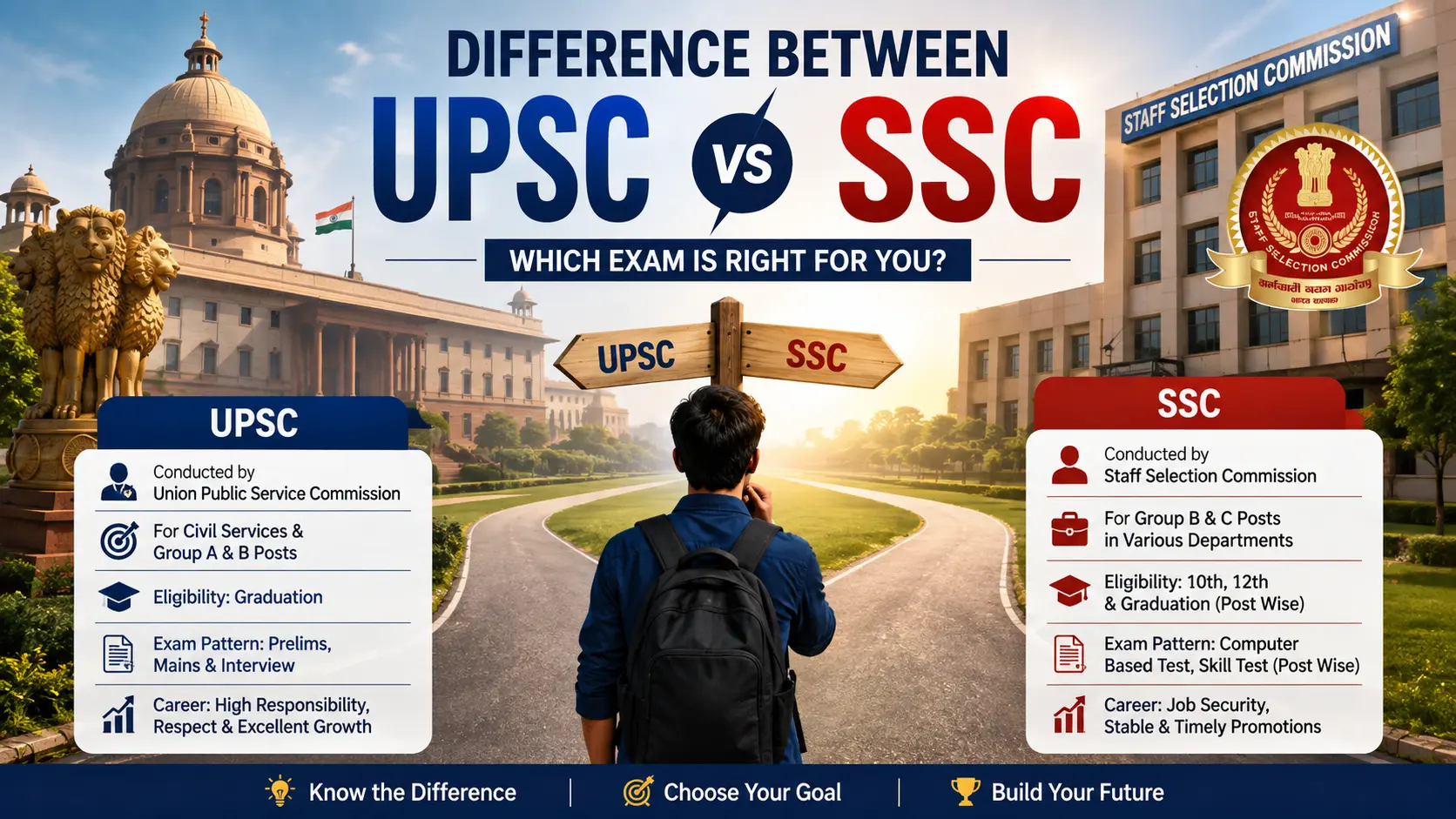
The biggest difference between UPSC and SSC is the nature and level of posts for which they recruit.
UPSC primarily recruits candidates for prestigious civil services and other higher-level government services, whereas SSC recruits candidates for a wide range of positions in central government ministries, departments and offices.
| Feature | UPSC | SSC |
|---|---|---|
| Full Form | Union Public Service Commission | Staff Selection Commission |
| Major Exam | Civil Services Examination | SSC CGL |
| Eligibility | Varies by examination; CSE requires graduation | Varies by examination |
| Qualification Range | Generally specialised qualifications or graduation for major exams | Class 10, 12, graduation and technical qualifications depending on exam |
| Major Posts | IAS, IPS, IFS, IRS and other services | Assistant, Inspector, Auditor, Accountant, Tax Assistant, JHT, MTS, JE, etc. |
| Competition | Extremely high | High, varies by examination |
| Exam Nature | Often extensive and multi-stage | Generally more objective and exam-specific |
| Career Responsibility | Policy implementation, administration, policing, diplomacy, revenue etc. | Departmental, administrative, technical and operational responsibilities |
| Preparation Level | Usually long-term and intensive | Depends on examination; can range from moderate to intensive |
| Suitable For | Aspirants targeting civil services and higher administrative roles | Aspirants seeking diverse Central Government opportunities |
Difference Based on Educational Qualification
One of the easiest ways to decide between UPSC and SSC is to look at your educational qualification.
If You Are a Class 10 Pass
If you have completed Class 10 and want a Central Government job, SSC may offer more suitable opportunities.
SSC conducts examinations such as MTS and other recruitment processes for eligible candidates. Eligibility varies from one notification to another, so candidates should always check the official recruitment notification before applying.
For a Class 10 pass candidate, SSC can therefore be an excellent starting point for entering government service.
If You Are a Class 12 Pass
Class 12 pass candidates can explore several SSC opportunities.
For example, SSC CHSL provides opportunities for various posts in central government departments and offices.
This makes SSC particularly attractive for candidates who want to start their government career soon after completing school education rather than waiting until graduation.
However, candidates should carefully check the educational requirements of the particular post because eligibility can vary.
If You Are a Graduate
Graduation significantly expands your options.
A graduate can consider both UPSC and SSC.
For UPSC Civil Services Examination, a bachelor's degree or an equivalent qualification is generally required. Graduates from arts, science, commerce, engineering, medicine and other disciplines can aspire to appear for the examination, subject to the applicable eligibility conditions.
SSC also offers major graduate-level opportunities, particularly through SSC CGL.
Therefore, graduates have a particularly wide choice:
Graduation → UPSC CSE / SSC CGL / Other Graduate-Level Government Exams
The decision should then be based on career ambition, interests and preparation style.
UPSC or SSC: Which Is Better After Graduation?
There is no universal answer.
If your ambition is to become an IAS, IPS, IFS or another civil service officer, UPSC Civil Services Examination is the obvious path.
If your objective is to secure a Central Government job through a comparatively more focused examination structure, SSC CGL and other SSC examinations may be more suitable.
A graduate should therefore ask:
"What kind of government career do I actually want?"
rather than simply asking:
"Which exam is easier?"
Difference in Examination Pattern
The examination structures of UPSC and SSC are considerably different.
UPSC Civil Services Examination
The Civil Services Examination generally consists of three major stages:
1. Preliminary Examination
The Preliminary Examination is the screening stage.
It generally consists of objective-type papers covering areas such as:
- General Studies
- Current Affairs
- History
- Geography
- Polity
- Economy
- Environment
- Science and Technology
- Aptitude
Candidates who qualify the prescribed cutoff proceed to the next stage.
2. Main Examination
The UPSC Main Examination is much more comprehensive.
It evaluates a candidate's ability to understand issues, analyse them and express ideas effectively through written answers.
It includes:
- Essay
- General Studies papers
- Optional subject papers
- Qualifying language papers
3. Personality Test
Candidates who qualify for the Main Examination are called for the Personality Test, commonly known as the interview.
The final ranking is prepared based on the applicable marks from the Main Examination and Personality Test.
SSC Examination Pattern
SSC examinations differ from one another, but many major SSC examinations rely heavily on objective-type computer-based tests.
Depending on the examination, candidates may encounter sections such as:
- General Intelligence and Reasoning
- Quantitative Aptitude
- English Language
- General Awareness
- Computer Knowledge
Some examinations also include additional stages such as skill tests, typing tests, physical tests or document verification, depending on the post.
The exact pattern should always be checked in the latest official notification.
Difference in Difficulty Between UPSC and SSC
Both UPSC and SSC are competitive examinations, but the nature of difficulty is different.
UPSC is widely considered one of India's most demanding competitive examinations because preparation requires a broad understanding of subjects, current affairs, analytical ability, answer writing and, for many candidates, a long preparation period.
SSC examinations generally place greater emphasis on speed, accuracy, reasoning, mathematics, English and general awareness, depending on the examination.
This does not mean that SSC is easy.
The number of candidates competing for available vacancies can make SSC examinations highly competitive.
The better question is:
Which examination matches your strengths?
If you enjoy reading, analysing social issues and writing detailed answers, UPSC may suit you.
If you are strong in mathematics, reasoning, English and solving objective questions quickly, SSC may suit you better.
Difference in Job Profile
UPSC Careers
UPSC services can involve significant administrative, policy-making, regulatory and field responsibilities.
An IAS officer, for example, may work in district administration, policy implementation or senior government administration during different stages of the career.
An IPS officer works primarily in policing and internal security.
An Indian Foreign Service officer can be associated with India's diplomatic and international affairs.
Other Central Services have their own specialised responsibilities.
These careers can involve substantial decision-making authority and public responsibility.
SSC Careers
SSC recruits candidates for numerous departments and organisations.
Depending on the examination and post, employees may work as:
- Inspectors
- Assistants
- Auditors
- Accountants
- Tax Assistants
- Clerks
- Stenographers
- Junior Engineers
- Multi-Tasking Staff
- Other departmental employees
The nature of work therefore varies considerably.
Some positions are primarily administrative, some involve taxation or auditing, while technical posts can involve engineering-related responsibilities.
Salary and Career Growth: UPSC vs SSC
Salary should not be the only factor when choosing a government examination.
UPSC services generally offer higher-level responsibilities and a structured career progression into senior administrative positions.
SSC posts also provide attractive government salaries, allowances, job security and opportunities for promotion.
The actual salary depends on the post, pay level, department, place of posting and applicable government rules.
A candidate should therefore compare the specific post rather than comparing "UPSC salary" with "SSC salary" as if each examination leads to a single salary.
Which Is More Competitive: UPSC or SSC?
Both are highly competitive, but competition works differently.
UPSC has a very demanding selection process, particularly because the Civil Services Examination involves multiple stages and evaluates candidates on a broad range of abilities.
SSC examinations can also have extremely large applicant pools, especially for popular examinations such as CGL , CHSL and GD.
Therefore, candidates should not select SSC merely because they believe it is "easy."
SSC is not an easy government job route. It is a different government job route.
Which Exam Should You Choose Based on Your Qualification?
Class 10 Pass
Consider: SSC examinations for which Class 10 qualification is sufficient.
Best approach:
Build strong fundamentals in mathematics, reasoning, English and general awareness and prepare for eligible recruitment examinations.
Class 12 Pass
Consider: SSC CHSL and other examinations for which 12th qualification is prescribed.
Best approach:
Develop speed and accuracy while strengthening English, mathematics, reasoning and general awareness.
Graduate
Consider: UPSC Civil Services Examination, SSC CGL and other graduate-level examinations.
Choose UPSC if:
- You aspire to civil services.
- You enjoy reading and analysing diverse subjects.
- You are comfortable with descriptive answer writing.
- You want a career involving administration, public policy or higher-level government responsibilities.
- You are prepared for a demanding, long-term preparation journey.
Choose SSC if:
- You want a Central Government job through graduate-level recruitment.
- You prefer objective-type examinations.
- You are strong in mathematics and reasoning.
- You enjoy solving questions quickly and accurately.
- You want to target specific departmental positions.
Can You Prepare for UPSC and SSC Together?
Yes, but with an important qualification: the two examinations should not be treated as identical.
There is considerable overlap in areas such as:
- General Awareness
- Current Affairs
- Indian Polity
- History
- Geography
- Economy
- General Science
However, UPSC requires substantial descriptive preparation, answer writing and broader analytical understanding.
SSC requires strong emphasis on speed, accuracy, quantitative aptitude, reasoning and English, depending on the examination.
A graduate can therefore use common subjects as a foundation while preparing separately for the examination-specific components.
UPSC vs SSC: Which One Should You Ultimately Choose?
The answer depends on your career destination, not the popularity of the examination.
If your dream is to serve as an IAS, IPS, IFS or another civil servant, UPSC deserves your focused preparation.
If you want a Central Government position in a ministry, department or other government organisation and your strengths align with objective competitive examinations, SSC can provide excellent opportunities.
There is also no rule that says a candidate must prepare for only one examination throughout their life.
Many aspirants begin with one examination and later change their strategy based on their qualification, performance and career goals.
How to Make the Right Decision
Before choosing an examination, ask yourself five questions:
1. What is my educational qualification?
Your qualification determines which examinations you are eligible for.
2. What kind of work do I want?
Administrative, police, diplomatic, taxation, auditing, technical and clerical careers are very different.
3. What are my strongest subjects?
Identify whether your strengths lie in mathematics, reasoning, English, general studies, writing or analytical thinking.
4. How much time can I devote to preparation?
UPSC generally demands a broader and more intensive preparation strategy. SSC preparation can also be demanding but may be more focused depending on the examination.
5. What is my long-term career goal?
Do not select an examination only because someone else succeeded through it.
Choose a career that you can see yourself pursuing for years.
Final Words for Government Job Aspirants
UPSC and SSC are not competitors in the sense that one is universally better than the other. They are different pathways to government service.
For a Class 10 or Class 12 pass candidate, SSC can open the door to Central Government employment through suitable examinations.
For graduates, the choice becomes much wider. SSC can lead to a variety of departmental positions, while UPSC can open the path to some of India's most prestigious civil services.
The most important thing is to match your qualification and strengths with the right examination.
Do not be discouraged by the number of candidates appearing for an examination. Every successful candidate once started with the same syllabus, the same uncertainty and the same question: "Can I really do it?"
The answer depends largely on your preparation, consistency and determination.
Choose your target carefully. Understand the examination. Build a realistic study plan. Practise regularly. Learn from your mistakes. And keep moving forward.
A government career is not achieved in a single day. It is built through hundreds of small efforts made consistently.
Whether your destination is UPSC or SSC, the journey begins with one decision: to start preparing seriously today.
Frequently Asked Questions (FAQs)
1. What is the main difference between UPSC and SSC?
UPSC primarily conducts examinations for prestigious civil services and other higher-level government services, while SSC conducts recruitment examinations for various posts in Central Government ministries, departments and offices.
2. Is UPSC harder than SSC?
UPSC Civil Services Examination is generally considered more demanding because of its broad syllabus, descriptive Main Examination and Personality Test. SSC examinations are also highly competitive but generally focus more on objective questions, speed and accuracy.
3. Can a 12th-pass student apply for UPSC?
For the UPSC Civil Services Examination, candidates generally need a bachelor's degree or an equivalent qualification. However, UPSC conducts several different examinations, and eligibility varies by examination.
4. Can a graduate apply for both UPSC and SSC?
Yes. A graduate can generally be eligible for UPSC Civil Services Examination as well as several SSC graduate-level examinations, subject to the specific eligibility conditions of each recruitment notification.
5. Which is better, UPSC or SSC?
Neither is universally better. UPSC may be more suitable for candidates aspiring to civil services and higher administrative responsibilities, while SSC can be a better choice for candidates seeking various Central Government departmental positions.
6. Which SSC exam is suitable for graduates?
SSC CGL is one of the major graduate-level examinations conducted by SSC. It provides recruitment opportunities for various posts in Central Government departments and organisations.
7. Which SSC exams are available for 12th-pass candidates?
SSC CHSL is a major examination for candidates who have completed Class 12. Other SSC recruitment opportunities may also be available depending on the post and notification.
8. Can I prepare for UPSC and SSC at the same time?
Yes, candidates can prepare for both, particularly because subjects such as General Awareness, History, Geography, Polity and Economy overlap. However, separate preparation is required for the examination-specific portions.
9. Is SSC easier than UPSC?
SSC should not simply be considered an easy alternative to UPSC. While the examination pattern and preparation requirements are different, SSC examinations can also be extremely competitive because of the large number of applicants.
10. Which exam is better for a government job after graduation?
Graduates can consider both UPSC and SSC. UPSC is suitable for candidates targeting civil services, while SSC CGL and other graduate-level SSC examinations are suitable for candidates interested in various Central Government posts.
11. Does UPSC offer better career growth than SSC?
UPSC services can provide opportunities for progression into senior administrative, regulatory, policing, diplomatic and other leadership roles. SSC posts also offer structured promotion, career progression and government benefits, depending on the post and department.
12. Should I choose UPSC or SSC based only on salary?
No. Salary should be only one factor. Candidates should also consider job responsibilities, career growth, work profile, posting, examination difficulty, preparation time and their long-term career interests.
 Join Telegram
  Join WhatsApp
  Join Facebook